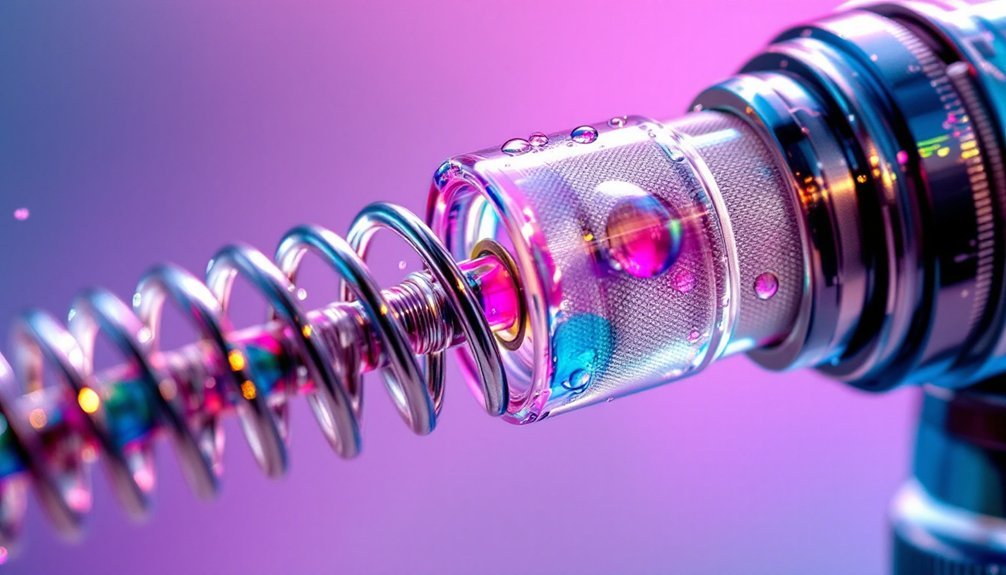
Your spray bottle nozzle contains several key components that work together for precise liquid dispensing. Inside, you'll find a spring-loaded trigger mechanism, one-way valves to prevent backflow, and an adjustable nozzle head for different spray patterns. The setup includes durable materials like stainless steel or high-grade plastics, along with specialized filters to prevent clogs. Understanding these parts can help you maximize your spray bottle's performance and longevity.
Our Recommended Products on Amazon


As an Amazon Associate we earn from qualifying purchases.
Essential Components of a Quality Spray Nozzle
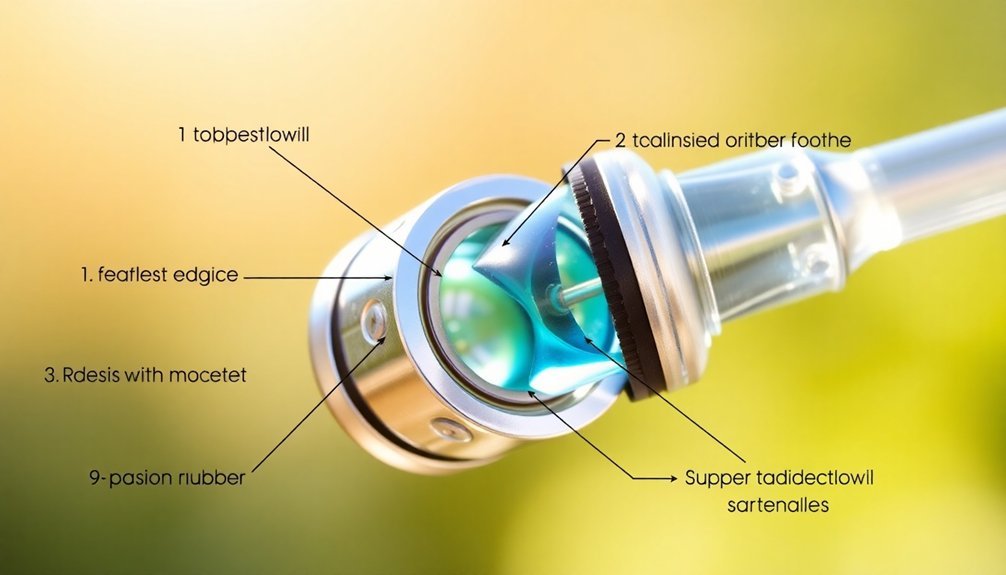
A quality spray nozzle combines several essential components that work together to deliver reliable performance.
A well-designed spray nozzle integrates key elements to ensure consistent, dependable operation with every use.
You'll find durable materials like stainless steel or high-grade plastics that resist corrosion and wear. The clog-resistant design prevents blockages, especially when you're working with thicker solutions like essential oils. The spring tension mechanism ensures the trigger returns smoothly after each spray.
At the heart of the system, you'll see one-way valves that prevent liquid backflow while ensuring smooth operation. The piston mechanism creates the necessary pressure for consistent spray delivery.
The nozzle's adjustable head lets you switch between different spray patterns, from a fine mist to a concentrated stream. For enhanced versatility, modern designs often include weighted tubes that allow spraying at any angle, while advanced materials help maintain peak performance throughout the nozzle's lifespan.
Different Types of Nozzle Patterns and Their Uses
You'll find that spray nozzles produce distinct patterns, from flat fan shapes for broad coverage to solid streams for precise targeting.
The pattern you choose directly impacts your application's effectiveness, whether you're cleaning, cooling, or applying chemicals.
Common designs incorporate adjustable tips that let you switch between patterns, giving you versatility for different tasks without changing the entire nozzle.
Pneumatic spray nozzles can generate finer fogs than standard hydraulic options, making them ideal for specialized applications.
Spray Pattern Fundamentals
Understanding spray patterns forms the foundation of effective nozzle selection and use.
You'll encounter three main patterns: full cone, hollow cone, and flat spray. Each serves distinct purposes in your applications.
When you need medium to large droplets for cooling or washing tasks, you'll want to use full cone patterns. They deliver a solid, conical spray distribution. These patterns excel at even bed distribution when spraying over packed surfaces.
For applications requiring finer droplets, like gas cooling or dust control, hollow cone patterns work best, creating a ring-like spray.
If you're applying herbicides or need uniform coverage, flat spray patterns are your go-to choice, producing a sheet-like spray.
The pattern you choose affects droplet size and distribution.
Remember that wider spray angles create smaller droplets, while narrower angles provide better penetration for your target surface.
Common Nozzle Design Features
While selecting the right nozzle can seem intimidating, each design serves a specific purpose in spray applications.
You'll find flat fan nozzles delivering even coverage for surface cleaning, while hollow cone nozzles create donut-shaped patterns perfect for reaching plant foliage. Full cone nozzles offer broader circular coverage when you need to treat larger areas.
For specialized tasks, you can choose solid stream nozzles that provide concentrated force for tank cleaning, or compound nozzles that combine multiple spray patterns.
The design mechanism matters too – some nozzles use liquid sheet breakup for finer droplets, while others employ pressure-swirl technology for better atomization.
Whether you're painting, cleaning, or gardening, understanding these basic nozzle types will help you choose the most effective option for your specific needs.
Selecting the Right Nozzle Material for Your Fragrance

When choosing between brass and plastic nozzles for your fragrance bottles, you'll find that brass offers superior durability and a more consistent spray pattern over time, though it comes at a higher cost.
Your selection of mist pattern design will greatly impact the fragrance's application, with options ranging from fine atomization to broader coverage.
You'll want to reflect on how the material choice affects the spray pattern, as brass nozzles typically maintain their designed pattern longer than plastic ones, which may deteriorate with repeated use.
Brass vs. Plastic Quality
Since fragrance enthusiasts often debate between brass and plastic nozzles, you'll need to weigh several factors before making your choice.
While brass nozzles offer reliable performance for moderate use, plastic alternatives might actually serve you better in the long run.
- Plastic nozzles can last 2-6 times longer than brass ones, making them a surprisingly durable choice for your fragrances.
- You'll find plastic nozzles are more cost-effective, combining lower initial costs with impressive longevity.
- Brass nozzles handle temperature changes well but may wear down faster if you're a frequent sprayer.
- When spraying corrosive ingredients, plastic nozzles offer better resistance than brass, though you'll want to check compatibility with your specific fragrance formula.
Consider your usage frequency and formula composition when deciding between these materials, as both can serve well in different scenarios.
Mist Pattern Design Options
Your choice of mist pattern can dramatically affect how your fragrance performs during application. When selecting a nozzle setup, you'll need to evaluate how the spray pattern delivers your scent. Fine mist spray bottles create tiny droplets through atomization under pressure, giving you the most even distribution for fragrances and essential oils.
You can adjust most nozzles to switch between fan and concentrated stream patterns, which affects your droplet size and coverage area. For fragrances, you'll want to focus on fine mist settings that provide consistent, even distribution.
Temperature also plays a key role – warmer liquids atomize more easily, while colder temperatures increase viscosity and can affect spray efficiency. Reflect on your specific needs when choosing between full cone, hollow cone, or fan patterns, as each serves different application purposes.
Proper Assembly Steps for Optimal Performance
To achieve ideal spray performance, proper assembly of your bottle nozzle requires careful attention to each component's placement.
Getting the assembly sequence right guarantees smooth operation and prevents leaks or malfunctions in your spray bottle system.
Proper assembly sequence is essential for a well-functioning spray system, eliminating potential issues before they start.
Follow these critical steps for peak assembly:
- Install the non-return valve inside the piston chamber to prevent liquid from flowing backward through the system.
- Position the spring between the stop and piston to create proper tension for smooth trigger action.
- Secure the trigger mechanism to the casing using the designated pins.
- Place the ball valve with bearings to establish one-way flow, then connect the nozzle and dip tube.
Remember to test the assembled unit by checking for smooth trigger action and consistent spray patterns before regular use.
Common Nozzle Problems and Quick Fixes
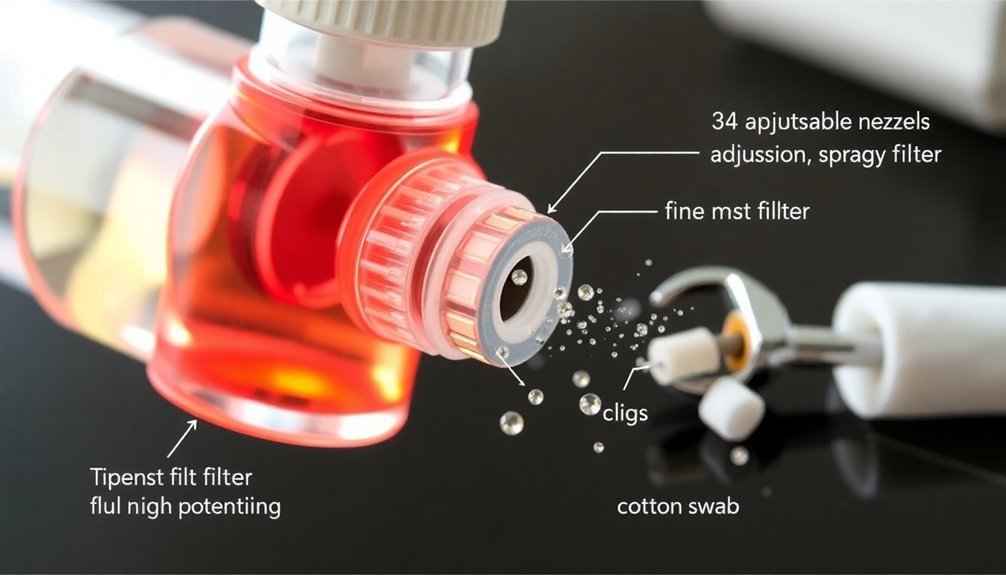
Even with proper assembly, spray bottle nozzles can develop issues that affect their performance over time.
You'll notice problems like erosion from high-pressure flow, corrosion from chemical interactions, or clogging from solid particles. Temperature changes and accidental damage can also impair your nozzle's function.
When issues arise, you can try several quick fixes. Start by cleaning the nozzle with hot water to remove blockages. If that doesn't work, check the alignment and adjust the nozzle settings.
For persistent problems, you might need to replace worn O-rings or damaged parts. To prevent future issues, filter your liquids before filling, handle the bottle with care, and maintain a regular cleaning schedule.
Choose nozzle materials that match your liquid's properties to avoid premature wear.
Maintaining Your Spray Bottle Mechanism
Your spray bottle's inner workings need regular cleaning to guarantee peak performance and longevity.
You'll want to focus on the nozzle, dip tube, and pump mechanism using a mixture of vinegar and water to dissolve mineral deposits and prevent stubborn buildup.
When cleaning these components, stick to soft-bristled brushes and avoid metal tools that could damage the delicate parts.
Cleaning The Inner Parts
While spray bottles may seem simple on the surface, their inner mechanisms require regular cleaning to maintain peak performance.
You'll need basic tools like cotton swabs, soft brushes, and protective gloves to properly clean each component.
For effective cleaning of your spray bottle's inner parts:
- Disassemble all components carefully, including the trigger, pump mechanism, dip tube, and nozzle.
- Soak parts in a vinegar-water solution to loosen dirt and residue.
- Use soft bristle brushes and cotton swabs to clean hard-to-reach areas.
- Rinse thoroughly and allow all parts to air dry completely before reassembly.
Don't forget to inspect each component for damage before cleaning.
A gentle approach with the right tools will help preserve your spray bottle's functionality while ensuring it remains free from contamination.
Preventing Clog And Buildup
To maintain ideal spray bottle performance, preventing clogs and buildup requires consistent attention to the nozzle mechanism.
You'll need to check the nozzle and dip tube regularly, even when the spray seems to work properly. Using filters or strainers helps remove particles that could cause blockages.
If you're working with thick or viscous fluids, consider heating them to improve flow and reduce buildup.
Select the right nozzle type for your specific fluid, preferably one with larger free passages if particulates are present. You can also opt for self-cleaning nozzles to minimize maintenance time.
Remember to prime the nozzle after each cleaning session and adjust spray patterns as needed.
These preventive steps will guarantee consistent spray quality and reduce the risk of unexpected clogs.
Fine Mist vs. Stream: Choosing Your Spray Pattern
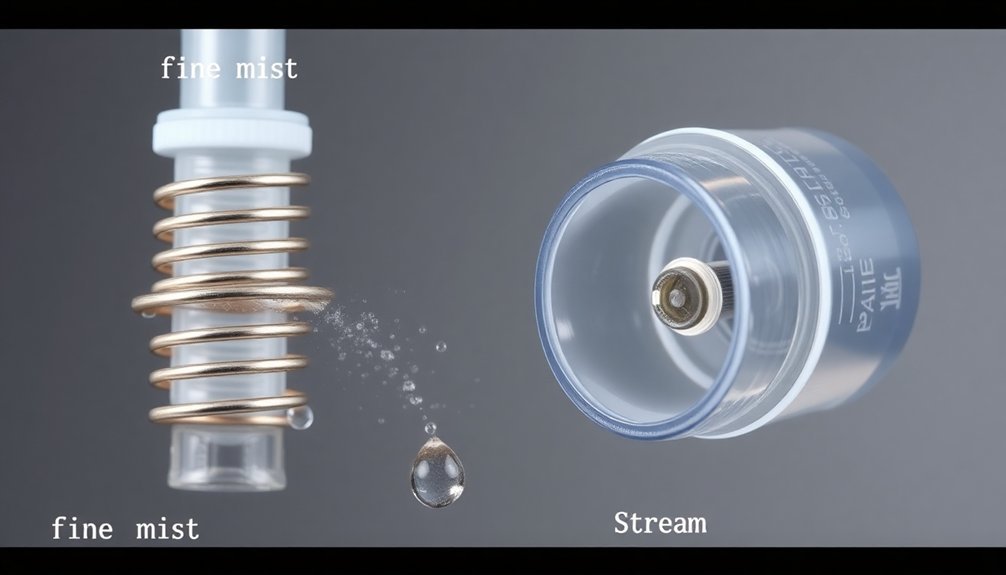
Selecting the right spray pattern can make or break your cleaning, gardening, or maintenance tasks. You'll need to decide between a fine mist or stream pattern based on your specific needs. Fine mist nozzles create tiny droplets (20-50 microns) perfect for even coverage, while stream nozzles deliver a concentrated flow for precise targeting.
Whether misting or streaming, choosing the right spray pattern directly impacts your task's success and efficiency through optimal liquid delivery.
Here's what to evaluate when choosing your spray pattern:
- Coverage needs – Mist patterns work best for broad surfaces and plant watering, while streams excel at spot cleaning.
- Distance requirements – Stream patterns reach further, making them ideal for hard-to-access areas.
- Liquid type – Fine mist works better with low-viscosity liquids, while streams handle thicker solutions well.
- Adjustability – Look for nozzles that let you switch between patterns for maximum versatility.
The Role of Filters in Nozzle Function
Proper filtration serves as the backbone of any spray bottle nozzle system, protecting your nozzle from potential clogs and ensuring consistent performance.
Your filter's main job is to catch particles, sediment, and other contaminants before they reach the nozzle opening.
You'll find different types of filters designed for specific needs. In-line filters work along the process line, while VEF filters are ideal for low-flow applications.
When choosing a filter, you'll need to balance filtration efficiency with flow rate – finer filters provide cleaner liquid but may restrict flow, while coarser ones allow higher flow rates but might let some particles through.
Remember to monitor your filter's performance through pressure drop indicators and stick to a regular maintenance schedule.
This proactive approach will extend your nozzle's life and maintain spray quality.
Best Practices for Nozzle Testing and Adjustment

While setting up a spray bottle nozzle is relatively straightforward, testing and adjustment require systematic evaluation to confirm peak performance.
You'll need to check both the spray pattern and flow rate to verify your nozzle delivers the right amount of liquid in the desired pattern.
- Start with a visual inspection of your nozzle for any signs of wear or damage, as these can affect spray performance.
- Test the spray pattern by spraying against a white background to check for even distribution.
- Adjust the operating pressure by tightening or loosening the nozzle until you achieve the desired spray characteristics.
- Calibrate your nozzle with the specific liquid you'll be using, as different fluids can affect spray performance differently.
Regular maintenance and testing will help prevent clogging and confirm consistent spray quality.
Cleaning and Storage Tips for Longevity
After testing and adjusting your spray bottle nozzle, maintaining its cleanliness and proper storage will dramatically extend its service life.
Start by soaking the nozzle in warm water to loosen debris, then use a vinegar solution and soft-bristled brush to remove stubborn grime. Don't forget to rinse thoroughly and dry completely.
Store your nozzle in a clean, dry place and use protective caps to prevent dust accumulation.
You'll want to regularly inspect for damage and maintain a cleaning schedule. To prevent clogs, install line strainers and guarantee chemical compatibility with your nozzle materials.
For stubborn blockages, try compressed air or carefully use a toothpick.
Consider investing in durable materials like cobalt alloy or PTFE, and avoid extreme temperatures that can degrade components.
Frequently Asked Questions
Can Spray Bottles Be Recycled With the Nozzle Mechanism Attached?
You'll need to remove the nozzle before recycling your spray bottle. Most recycling programs don't accept nozzles due to their mixed materials, but you can typically recycle the plastic bottle separately.
What Causes Some Spray Bottles to Make a Whistling Sound?
Your spray bottle whistles when air mixes with liquid through narrow openings in the nozzle. High-speed flow, partial blockages, or trapped air bubbles can create these high-pitched sounds during spraying.
How Long Does the Average Spray Bottle Mechanism Last?
Your spray bottle's lifespan varies greatly, but you'll typically get 1-2 years of regular use. With proper maintenance and cleaning, it can last longer, though the pump mechanism may eventually wear out.
Why Do Some Sprayers Work Upside Down While Others Don't?
Your sprayer's ability to work upside down depends on its tube design. Upside-down sprayers use specialized dip tubes that follow gravity, while standard sprayers have fixed tubes that can't access liquid when inverted.
Are Spray Bottle Mechanisms Interchangeable Between Different Manufacturer Bottles?
You'll find spray bottle parts aren't always interchangeable between manufacturers. While some share standard neck sizes like 28-400, you'll need to check thread types and nozzle designs for proper compatibility.