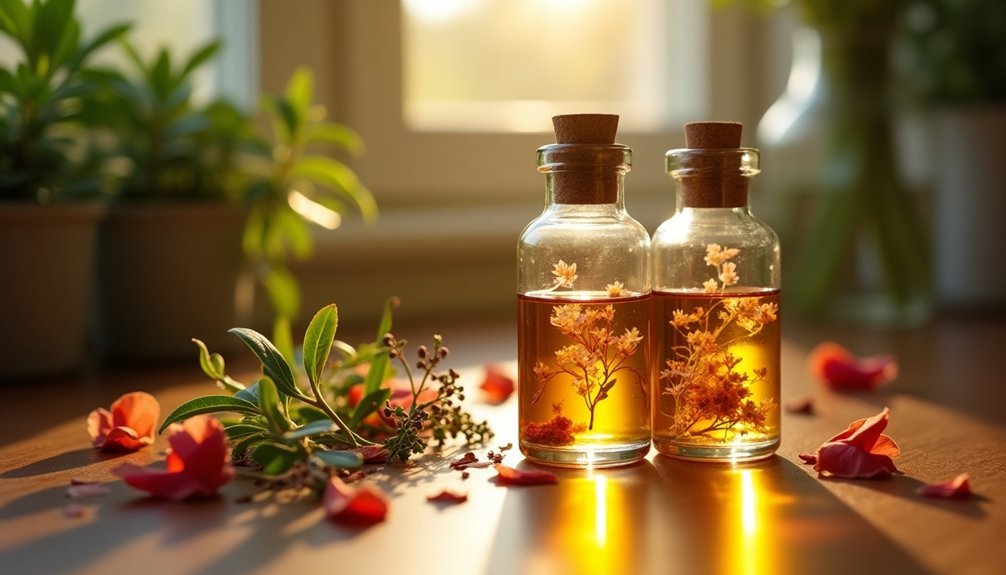
To stabilize your organic perfumes naturally, combine proven fixatives like benzoin, frankincense, and myrrh at 3-5% concentration with your fragrance blend. You'll want to store your creations in dark glass bottles at stable temperatures between 10-21°C. Use a 30:50:20 ratio for top, middle, and base notes, starting with a jojoba oil base. For maximum stability, incorporate cedarwood and patchouli as anchoring agents. These fundamentals just scratch the surface of crafting enduring natural scents.
Understanding the Role of Natural Fixatives
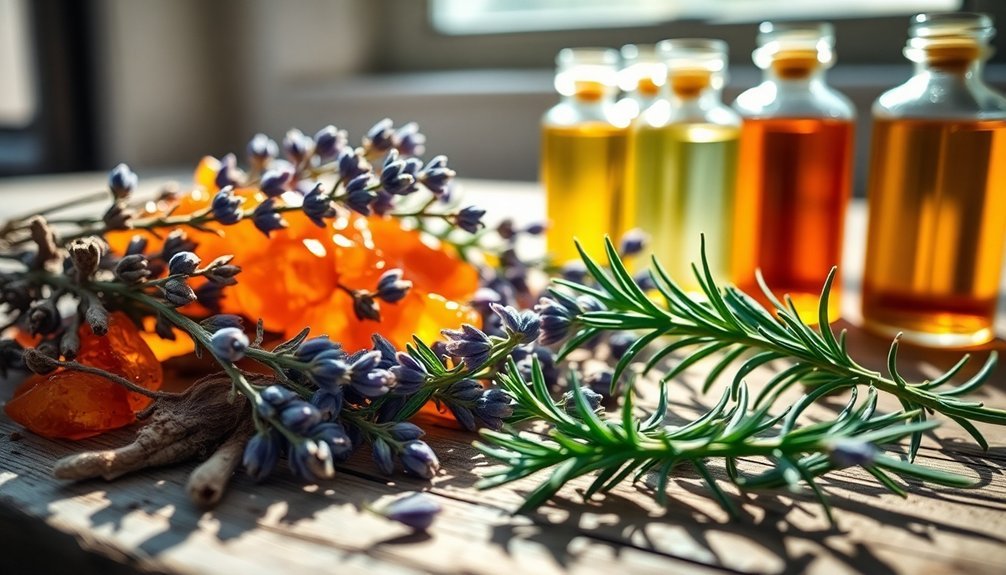
When crafting organic perfumes, natural fixatives play a crucial role in stabilizing and enhancing your fragrance compositions. You'll find these essential ingredients work by binding to scent molecules, effectively slowing down their evaporation rate and ensuring your perfume maintains its intended character over time.
Natural fixatives don't just extend your fragrance's longevity; they create a more sophisticated scent profile. They anchor the fragrance to your skin while preventing rapid breakdown of volatile compounds, resulting in better projection and sillage. Among the most effective options, cedarwood and frankincense provide exceptional anchoring properties.
You'll notice how fixatives like patchouli, oakmoss, and sandalwood add depth and complexity to your blend, helping balance different notes throughout all stages of evaporation. By incorporating these natural stabilizers, you're ensuring your organic perfume diffuses evenly and maintains its aromatic integrity for longer periods.
Essential Plant-Based Fixatives for Long-Lasting Scents
As you explore plant-based fixatives, you'll discover that these natural ingredients form the backbone of long-lasting organic perfumes. The key is using ingredients like benzoin, frankincense, and myrrh at a 3-5% concentration to slow down evaporation and balance vapor pressures. Today's perfume manufacturers are focusing on creating high-quality formulations that maximize the use of natural fixatives.
| Fixative | Best For | Key Properties |
|---|---|---|
| Benzoin | Ambery Scents | Sweet, seductive, body-giving |
| Patchouli | Light Notes | Earthy, anchoring, rich |
| Sandalwood | All Blends | Creamy, woody, extending |
You'll find that combining these fixatives with resinoids enhances stability while maintaining projection. The secret lies in strategic blending – pair labdanum for leathery warmth, vanilla Madagascar for depth, and clary sage for musky undertones. These natural solutions won't just stabilize your perfume; they'll add complexity to your organic creations.
Harnessing the Power of Resinoids in Perfumery
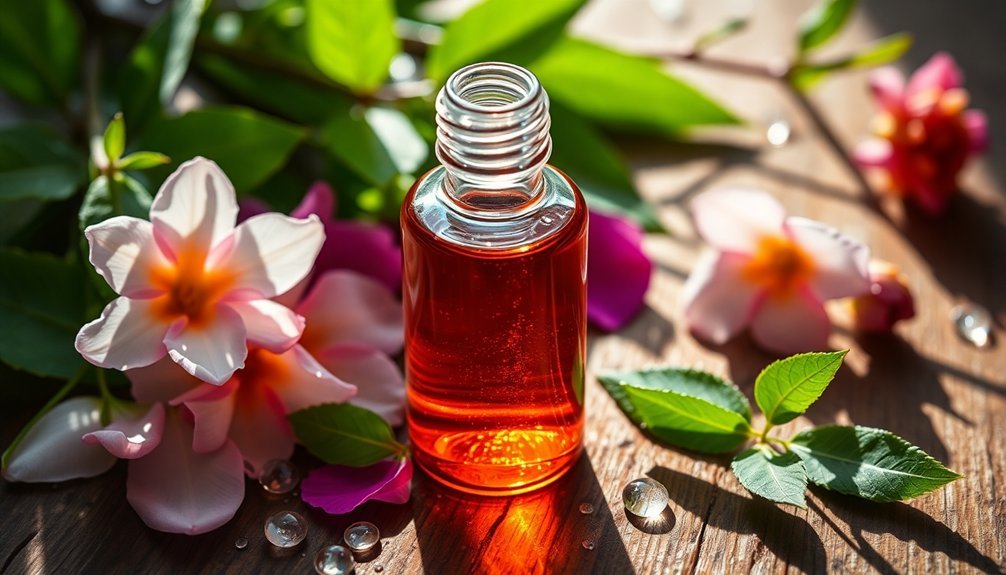
You'll find resinoids' unique molecular structure acts as a powerful anchor, helping to bond volatile fragrance molecules to your skin for extended periods.
These natural extracts work in perfect harmony with other organic fixatives, creating a synergistic effect that enhances the overall longevity of your perfume.
When you combine resinoids with complementary plant-based ingredients, you're not just extending wear time—you're also enriching the fragrance's depth and complexity. The addition of Tolu resinoid brings a sophisticated balsamic sweet odor that particularly elevates Oriental and chypres fragrances.
Resinoids' Molecular Anchoring Properties
Understanding resinoids' molecular anchoring properties reveals one of perfumery's most fascinating phenomena.
When you're crafting your organic perfumes, these complex molecules work as natural anchors, dramatically slowing down the evaporation of your fragrance's volatile top and middle notes.
The science behind this stability lies in resinoids' larger molecular structure and intricate shapes. They create resistance to evaporation, ensuring your scent stays longer on your skin.
- Feel the warmth as tonka bean resinoid wraps your fragrance in its almond-sweet embrace
- Experience the lasting opulence of frankincense and myrrh in your oriental blends
- Watch your perfume evolve beautifully throughout the day
- Trust in nature's own time-release mechanism for enduring scent
This molecular anchoring makes resinoids essential fixatives in organic perfumery, helping you create fragrances that truly stand the test of time.
Natural Fixative Synergy Benefits
When natural fixatives work together in organic perfumery, they create a powerful synergistic effect that goes beyond their individual properties. You'll notice how these fixatives work in harmony to slow down evaporation while anchoring scents to your skin, creating a longer-lasting fragrance experience. They don't just stabilize your perfume; they enhance its overall aroma and diffusion characteristics.
| Synergistic Effect | Benefit to You |
|---|---|
| Evaporation Control | Your fragrance stays potent longer |
| Skin Anchoring | Scent adheres better to your skin |
| Aroma Enhancement | You get richer, more complex notes |
| Stability Control | Your perfume maintains its original scent |
| Improved Diffusion | Better projection and sillage |
The Art of Solubilizing Organic Fixatives
When you're working with organic fixatives in perfumery, you'll need to master the precise ratios between water and oil components, typically ranging from 1:1 to 5:1 with natural solubilizers like Polysorbate 20 or Biosolv.
You'll find that selecting the right natural solubilizer is essential, as each type interacts differently with various organic fixatives and base materials.
Temperature control during the solubilizing process directly impacts the stability of your blend, so you'll want to maintain consistent conditions while mixing your ingredients.
Water-Oil Blend Ratios
Mastering the delicate balance between water and oil components lies at the heart of creating successful organic perfumes.
You'll need to work with precise ratios of fragrance oils, typically 1-3% of your total batch weight, and match them with appropriate solubilizers at ratios between 1:4 and 1:8.
For ideal results with your organic blends, consider these emotional touchpoints:
- The thrill of achieving crystal-clear perfection when you hit the exact ratio
- The satisfaction of watching oils seamlessly dissolve into your water base
- The confidence of knowing your creation will remain stable over time
- The pride of mastering a professional-grade formulation technique
Test small samples before scaling up, and don't hesitate to adjust your ratios if needed.
Natural Solubilizer Selection
Since organic perfumery demands pristine clarity and stability, choosing the right natural solubilizer becomes essential for your formulation's success.
You'll find excellent options in Biosolv and POLYSOL® products, which offer superior performance while maintaining eco-friendly standards.
When selecting your solubilizer, focus on its HLB value and compatibility with your chosen essential oils.
You'll want to guarantee it's derived from natural sources and meets clean beauty standards. Consider adding organic propanediol to your solubilizer-fragrance mixture for enhanced stability and clarity.
Remember to test your solubilizer's effectiveness through compatibility checks before scaling up production.
Always follow the recommended ratios and mixing techniques – pre-mix your oils with the solubilizer first, then slowly incorporate the blend into your water base while avoiding excess foam formation.
Temperature Impact Control
The delicate balance between temperature and fragrance stability plays a crucial role in organic perfumery's success. Your natural perfumes thrive in cooler environments around 55-60°F (13-15°C), where organic compounds remain stable and evaporate more slowly.
You'll want to protect your precious blends from heat, which can rapidly degrade essential oils and alter their intended composition.
- Feel confident knowing your perfumes are safe in a temperature-controlled cabinet
- Experience peace of mind by storing your fragrances away from sunlight and heat sources
- Embrace the power of natural fixatives like cedarwood and patchouli to anchor your scents
- Trust in the protective qualities of cool, stable environments for your organic creations
Keep your organic perfumes in interior closets or refrigerated spaces, and they'll maintain their integrity and enchanting aromatics for much longer.
Natural Stabilization Techniques for DIY Perfumes
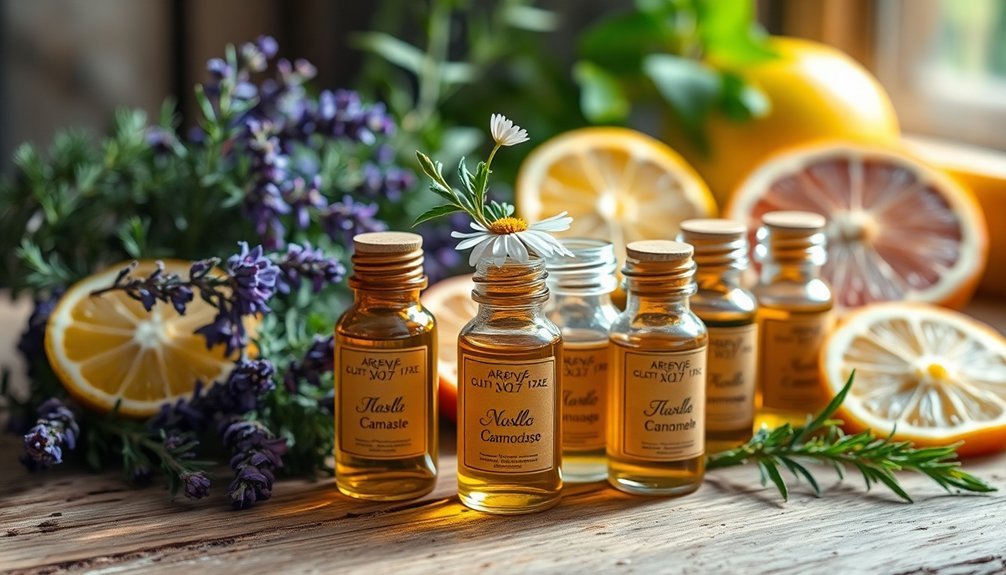
Creating stable DIY perfumes requires a deep understanding of natural fixatives and preservation methods. You'll find success by incorporating natural fixatives like benzoin and orrisroot, which create a matrix that entraps your fragrance molecules and prevents quick evaporation.
Start by infusing herbs, spices, and flowers to create your base notes, then blend these with your chosen essential oils. You'll want to test the stability of your creation under various conditions, particularly UV exposure and temperature changes.
Store your raw materials and finished perfumes in air-tight containers to maintain their potency.
Don't skip the vital maceration process – let your perfume mature for several weeks. This enhances the effectiveness of your natural fixatives and guarantees a more stable, long-lasting scent that won't deteriorate quickly.
Creating Balanced Blends With Organic Materials
You'll find success in organic perfumery by following natural ratios of top, middle, and base notes in proportions of 30:50:20 respectively.
When working with organic materials like vanilla absolut and lavender, layer your fixatives effectively by starting with a jojoba oil base and gradually incorporating each aromatic element.
The careful balance of these organic components creates a harmonious blend that maintains its stability while showcasing the distinct character of each ingredient.
Natural Ratios For Harmony
When crafting organic perfumes, understanding natural ratios forms the foundation of a harmonious blend. You'll want to follow the classic 30-50-20 distribution of top, middle, and base notes, though you can adjust these ratios to match your vision.
Remember that natural ingredients work together like a symphony, each contributing its unique character to the final composition.
- Feel the bright, uplifting burst of citrus top notes dancing on your skin
- Experience the romantic heart of blooming flowers in the middle notes
- Embrace the grounding wisdom of ancient woods in the base
- Connect with nature's raw power through pure, untamed essences
Start with small batches, adding just 5 drops at a time as you perfect your blend.
Let your creation age naturally, allowing the notes to mature into a balanced masterpiece.
Layering Fixatives Effectively
The art of layering fixatives transforms a fleeting fragrance into a lasting masterpiece. You'll want to focus on incorporating these stabilizing elements into your base notes, typically using 3-5% of your total formula. Natural options like benzoin, frankincense, and myrrh can provide excellent staying power while maintaining organic integrity.
| Fixative Type | Best Pairings | Usage % |
|---|---|---|
| Resinoids | Rose, Violet | 3-4% |
| Tinctures | Citrus, Herb | 2-3% |
| Gums | Woods, Spice | 4-5% |
| Powders | Floral, Sweet | 2-4% |
When selecting your fixatives, consider both their stabilizing properties and how they'll complement your fragrance profile. For instance, sandalwood and vanilla work exceptionally well across various blends, while myrrh specifically enhances violet, rose, and lavender notes.
Time-Tested Storage Methods for Fragrance Preservation
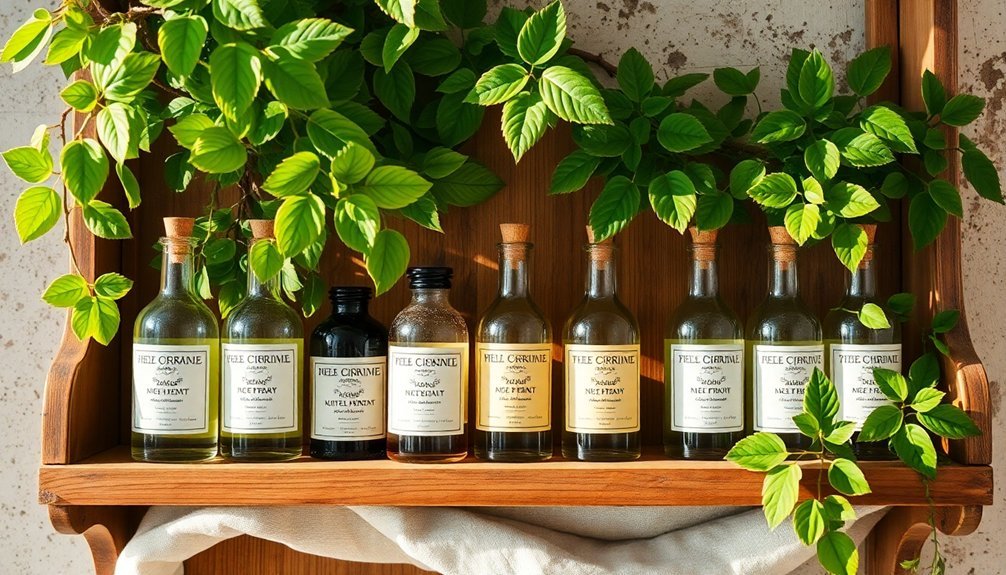
Preserving your organic perfumes requires careful attention to storage methods that have proven effective over generations.
You'll want to store your fragrances in a cool, dark place where temperatures remain stable between 10°C and 21°C. Keep your bottles in their original packaging and always verify caps are tightly sealed to prevent oxidation.
- Feel confident knowing your precious scents are protected in a dedicated perfume cabinet away from bathroom humidity
- Experience peace of mind by rotating your collection regularly to catch any changes in fragrance or appearance
- Enjoy your perfumes' longevity by using an atomizer for daily applications
- Trust in the protection of original, dark-glass bottles that shield against harmful UV rays
Consider investing in a specialized perfume refrigerator for ideal temperature control during extreme weather conditions.
Mastering the Maceration Process
Mastering maceration stands as a cornerstone of organic perfume creation, where you'll discover the art of blending and maturing fragrances to achieve their full potential.
You'll need to mix your fragrance oils with a suitable organic alcohol solvent and store the mixture in a cool, dark place away from direct sunlight.
During maceration, you'll witness fascinating chemical transformations. The process involves oxidation, esterification, and the formation of new compounds that enrich your perfume's complexity.
You can customize the duration from a few days to several months, depending on your desired outcome. The longer you let it mature, the more refined your scent will become.
Remember to monitor the temperature and environment, as these factors considerably influence the final result.
After maceration, filter your perfume before bottling to guarantee a balanced, sophisticated fragrance.
Quality Control for Homemade Natural Perfumes
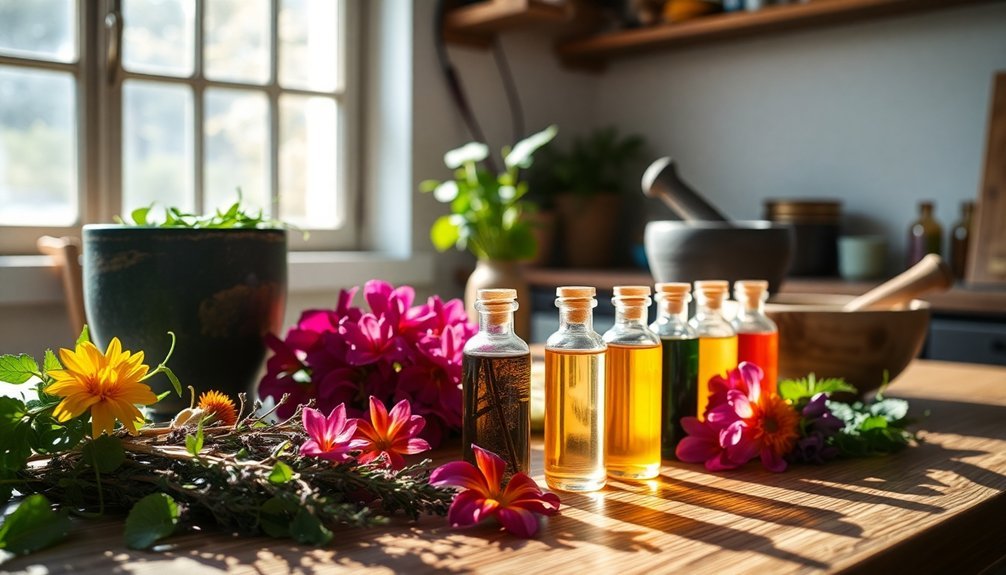
Creating consistently high-quality natural perfumes requires a systematic approach to quality control that begins with ingredient authentication.
You'll need to verify each raw material's purity and obtain certificates of analysis from trusted suppliers. Test your perfume's stability by exposing it to different temperatures and light conditions, and always store your creations in dark bottles away from direct sunlight.
- Feel confident knowing your ingredients are pure and ethically sourced
- Experience the joy of creating consistently beautiful fragrances batch after batch
- Take pride in maintaining professional-level quality standards at home
- Rest easy knowing your perfumes will maintain their integrity over time
Incorporate regular olfactory evaluations throughout your process, comparing each batch to your benchmark sample.
Use proper storage techniques and maintain detailed records of your procedures to guarantee your natural perfumes meet the highest quality standards.
Selecting the Right Natural Fixative Combinations
When you're developing natural perfumes, selecting the right fixative combinations can make or break your final creation. You'll want to start by understanding your fragrance's core characteristics and choose fixatives that complement them. For floral scents, try combining sandalwood with vanilla, while woody fragrances benefit from cedarwood and patchouli pairings.
| Fragrance Type | Primary Fixative | Supporting Fixative |
|---|---|---|
| Floral | Sandalwood | Vanilla |
| Citrus | Balsam of Peru | Frankincense |
| Woody | Cedarwood | Patchouli |
| Spicy | Myrrh | Cistus |
You'll need to experiment with small quantities first, as natural fixatives can vary in strength. Keep detailed notes of your combinations and remember that environmental factors can affect each batch's scent profile.
Environmental Factors Affecting Perfume Stability
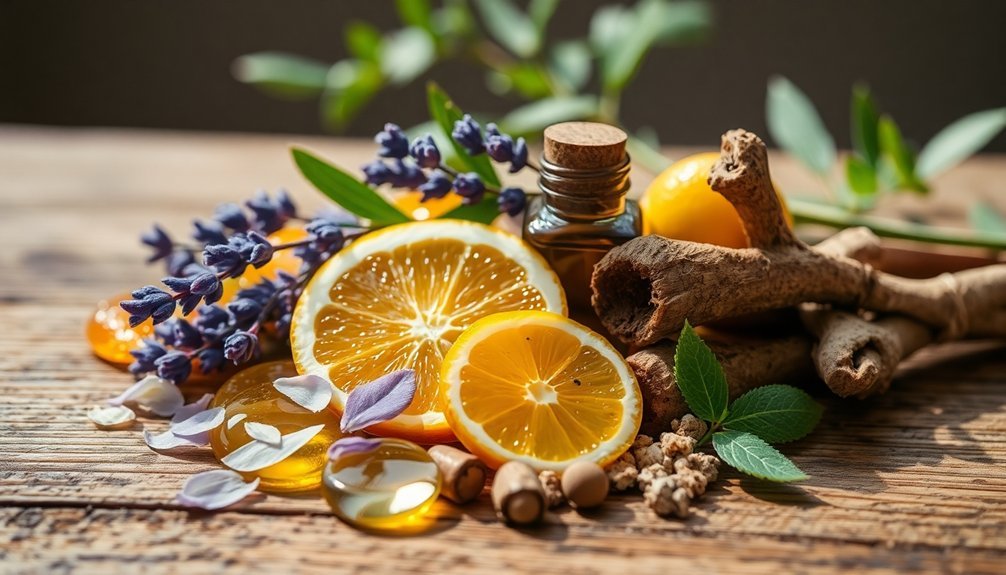
Understanding how environmental factors affect your organic perfume can help you maximize its performance and longevity. Temperature and humidity play vital roles – warmer conditions amplify projection but reduce longevity, while humidity helps lock in the fragrance.
At higher altitudes, you'll notice your perfume projects strongly initially but fades faster due to thinner air.
- Your perfume won't perform the same way on a hot beach as it does in an air-conditioned room.
- You'll get better longevity in humid climates, where moisture helps trap the scent.
- Urban pollution can transform your fragrance's character, making it smell different than intended.
- Your perfume needs extra protection in extreme conditions to maintain its organic integrity.
To optimize performance, consider applying moisturizer before your perfume in dry conditions and choosing lighter fragrances in humid environments.
Measuring and Testing Your Organic Formulations
Precise measurements and rigorous testing form the foundation of successful organic perfume formulation. You'll need accurate scales that measure to 0.01g, as drops aren't reliable for consistent results.
Always calculate concentrations based on total volume, using percentages instead of drops for precise formulations.
When mixing your organic perfumes, add fragrance oils to alcohol gradually while stirring thoroughly. Let your creation mature for several weeks to achieve harmonious blending.
To guarantee stability, conduct accelerated tests including freeze-thaw cycles and high-temperature exposure. Monitor changes in pH, viscosity, color, and odor during these tests.
You'll want to evaluate your samples at regular checkpoints during testing to determine if your formula remains stable for at least one year.
Use the Turbiscan Stability Index to assess emulsion stability and perform microbial tests to verify preservation effectiveness.
Troubleshooting Common Stability Issues
Stability challenges can emerge even in well-tested organic perfume formulations. You'll need to monitor four key areas: color changes, fragrance integrity, viscosity shifts, and pH balance.
When you notice your perfume changing color or developing an off-putting scent, it's essential to act quickly.
Common stability issues can trigger these emotional responses:
- Frustration when your carefully crafted scent suddenly turns rancid
- Disappointment upon discovering unsightly phase separation
- Anxiety over unexpected color changes in your product
- Concern about preservative effectiveness and safety
To maintain stability, consider using single molecule fragrances, adjusting your pH to slightly acidic, and incorporating UV absorbers.
You can also enhance stability by carefully selecting compatible ingredients and performing thorough stability tests, including freeze-thaw cycles.
Frequently Asked Questions
Can Pregnancy Affect How Organic Perfumes Interact With My Skin?
Yes, your pregnancy hormones can alter how organic perfumes smell and react on your skin. You'll notice increased sensitivity, and some scents may trigger nausea due to your heightened sense of smell.
Why Do Some Natural Perfumes Smell Different on Different People?
Your unique skin chemistry, diet, and genetics create a personal scent fingerprint. When you wear natural perfumes, they interact with your body's pH levels, oils, and bacteria, creating a distinctive fragrance that's all yours.
Are Organic Fixatives Safe for People With Nut Allergies?
If you have nut allergies, be cautious with organic fixatives that contain nut oils. You'll want to check if they're refined or unrefined, as unrefined oils pose a higher risk of causing allergic reactions.
How Do Seasonal Changes Affect the Performance of Organic Perfumes?
You'll notice your organic perfumes perform differently across seasons. They'll evaporate faster in summer heat, last longer in humid conditions, and need heavier application in winter when natural ingredients react more slowly.
Can Medications Alter the Way Natural Perfumes Work on Skin?
While medications don't directly affect how natural perfumes work, they can make your skin more sensitive. You'll want to patch-test perfumes and consult your doctor if you're taking medications affecting skin health.
In Summary
By implementing these organic stabilization techniques, you'll transform your natural perfumes from fleeting scents into long-lasting fragrances. Whether you're using essential oils, resinoids, or plant-based fixatives, remember that patience and precise measurements are key. Don't forget to test your formulations thoroughly and adjust for environmental factors. With practice, you'll master the art of creating stable, sustainable perfumes that rival commercial alternatives.



Leave a Reply