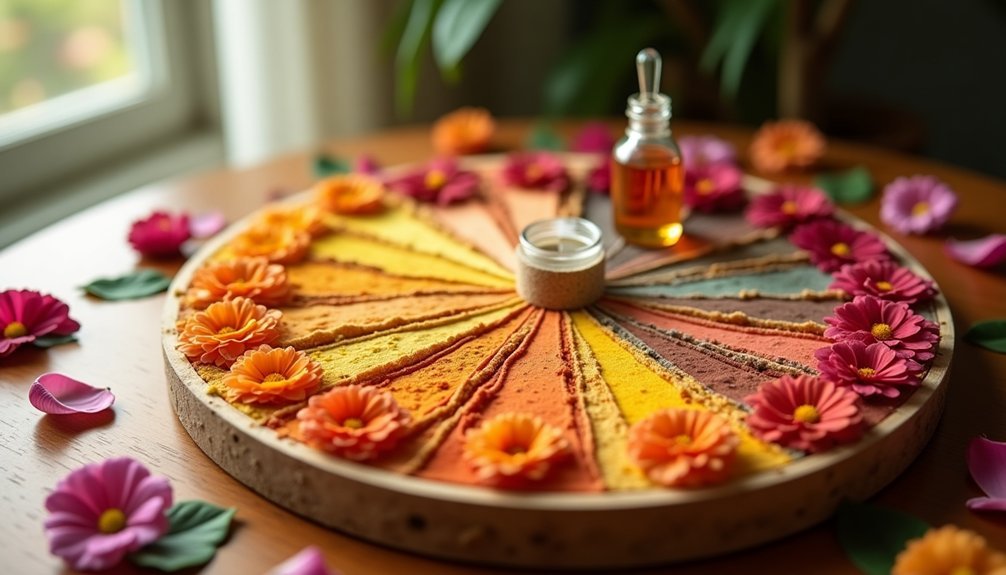
Start your fragrance blending journey by mastering the wheel's four main families: Floral, Fresh, Woody, and Oriental. You'll find success using the 30-50-20 ratio for top, middle, and base notes. Keep adjacent scents natural, experiment with opposites for complexity, and document every blend in detail. Test small batches on blotter strips, and maintain a fragrance journal to track winning combinations. These foundational tips will open your path to creating signature scent profiles.
Understanding Basic Fragrance Wheel Dynamics
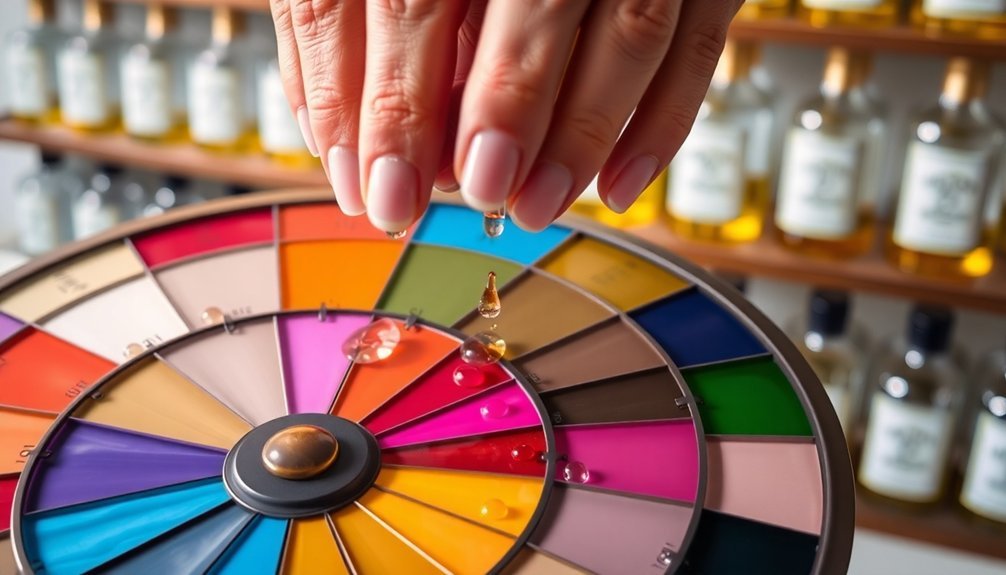
When you're first exploring fragrance blending, the fragrance wheel serves as your essential roadmap to successful scent combinations. By understanding its four main families – Floral, Fresh, Woody, and Oriental – you'll quickly grasp how different aromas interact with each other.
You'll notice that complementary scents sitting next to each other on the wheel naturally blend well due to their shared characteristics. For more adventurous combinations, try pairing fragrances from opposite sides of the wheel to create unique scents with depth and complexity.
As you explore each category's specific notes, you'll develop a better understanding of how different scents work together. Don't be afraid to experiment – the fragrance wheel is designed to encourage creative combinations while providing a structured approach to developing your signature blends.
Selecting Complementary Scent Combinations
You'll find that combining adjacent fragrance families on the wheel, like pairing floral notes with light florals or citrus, creates naturally harmonious blends.
When you want to make bold statements, try matching contrasting scents from opposite sides of the wheel, such as fresh citrus with deep woods or sweet vanilla with spicy notes.
Your seasonal blending can follow nature's lead by selecting light, fresh combinations for spring and summer while opting for warmer, richer pairings during fall and winter months.
Adjacent Fragrance Family Pairings
Creating harmonious fragrance blending becomes remarkably intuitive once you understand adjacent family pairings on the fragrance wheel.
When you combine scents from neighboring families, you'll discover naturally complementary combinations that enhance your overall fragrance profile.
Try pairing Floral with Fruity notes to create an elegant, sweet composition, or blend Fresh citrus elements with Woody bases like sandalwood for a balanced, grounding effect.
You'll find that mixing Soft Floral with Floral Amber creates sophisticated depth, while combining Aromatic and Floral notes delivers an uplifting, seasonal appeal.
Contrasting Scent Combinations
Though adjacent scents blend naturally, exploring contrasting combinations across the fragrance wheel can yield surprisingly sophisticated results. You'll discover that pairing opposite fragrance families creates depth and intrigue in your scent combinations. When crafting contrasting notes, guarantee each scent maintains its distinct character while harmonizing with its counterpart.
| Contrasting Note | Complementary Match |
|---|---|
| Floral | Woody |
| Citrus | Spicy |
| Fresh Green | Oriental |
| Marine | Amber |
| Fruity | Musk |
To create balanced fragrance blends, pair strong scents with subtle ones, allowing each note to shine through without overwhelming the mix. You'll find that complementary scents from opposite sides of the fragrance wheel can evoke powerful emotional responses, making your blends more memorable and meaningful.
Seasonal Blending Groups
The art of seasonal fragrance blending transforms everyday scents into powerful sensory experiences that align with nature's rhythms.
You'll find that each season calls for distinct notes that capture its unique character and mood.
Start your spring blends with light floral notes like jasmine and peony, complemented by fresh green accents.
For summer fragrance combinations, mix bright fruity notes with aquatic elements to evoke beachy, sun-soaked days.
When autumn arrives, create cozy blends using warm vanilla and amber bases, enhanced with spicy notes of cinnamon and clove.
Winter calls for crisp, invigorating scents – try combining woody cedarwood with revitalizing peppermint or pine.
These seasonal groupings help you craft perfectly balanced fragrances that reflect the changing moods and atmospheres throughout the year.
Balancing Top, Middle, and Base Notes
When crafting a balanced fragrance blend, understanding the interplay between top, middle, and base notes becomes essential for achieving a harmonious scent profile.
You'll want to mix and match your fragrance oil blending components following the 30-50-20 ratio rule: 30% top notes, 50% middle notes, and 20% base notes.
Start with lighter, volatile scents like citrus and herbs for your top notes, which create the initial impression.
Then, incorporate floral and spicy middle notes to build character and bridge your composition.
Finally, anchor your blend with long-lasting base notes such as sandalwood or vanilla.
As you experiment with balancing top, middle, and base notes, document your combinations and adjust incrementally.
This methodical approach will help you develop complex, well-structured fragrances that evolve beautifully over time.
Mastering Cross-Family Fragrance Pairings

Mastering cross-family fragrance combinations opens up endless possibilities for creating distinctive signature scents. When you mix fragrances from different families, you'll discover unique aromas that elevate your olfactory experience beyond traditional blends.
Start by exploring adjacent families on the fragrance wheel, like pairing fruity notes with citrus elements for a vibrant scent profile. You'll find that combining woody undertones with ambery sweetness creates depth and sophistication.
When working with contrasting families, such as Fresh and Oriental, focus on achieving balance so each note complements rather than overpowers the other.
Keep track of your successful combinations in a fragrance journal. This practice helps you refine your blending technique and guarantees you can recreate your favorite scent pairings.
Creating Signature Scent Triads
Crafting signature scent triads elevates your fragrance blending to an art form by combining three complementary notes into a harmonious composition. When you mix fragrances, select scents from adjacent families on the fragrance wheel to guarantee natural compatibility and flow between the aromas.
Start by experimenting with different fragrance ratios, particularly the 2:1:1 proportion, where you'll emphasize one dominant scent while allowing the other two to provide depth and complexity.
Use the fragrance wheel as your guide to choose scents that match your intended mood or occasion, whether you're creating a signature scent for relaxation or celebration.
Remember to maintain detailed records of your successful combinations, including specific oils and proportions used. This documentation will help you refine your blends and recreate your favorite triads consistently.
Testing and Documenting Blend Ratios
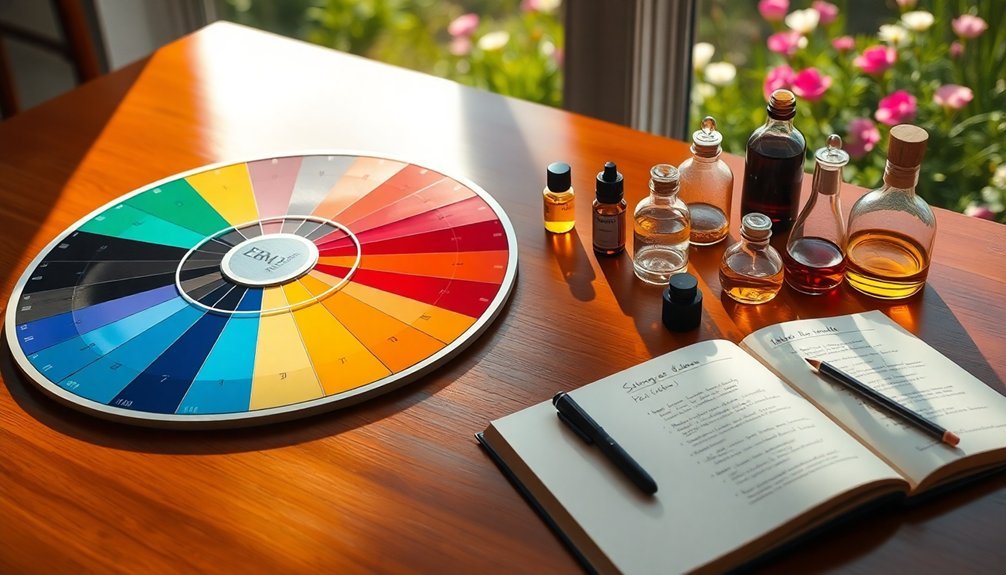
You'll want to track every drop you mix in your fragrance blending chart, using a precise pipette or dropper to measure 2-3 drops of each oil in your test batches.
Creating successful blends requires detailed documentation of your ratios, allowing you to replicate your favorites and learn from less successful attempts.
Maintain organized records of your experimentation process, including notes about scent evolution after the 24-hour settling period and any adjustments needed to achieve your desired fragrance profile.
Log Every Drop Mixed
The single most essential step in successful fragrance blending is maintaining a thorough record of your experimentation. As you log every drop mixed, you'll need to use precise measuring tools like droppers or pipettes to track exact quantities.
Keep detailed notes of each oil's contribution to your blend and how scents can become more complex over time.
When you experiment with different combinations, document the evolution of your fragrance on blotter strips, noting how the scent changes during the drying process.
Record any modifications you make along the way, including your reasoning behind each adjustment. This systematic approach helps you create a fragrance that reflects your vision while building a valuable reference for future blending projects.
Your journal becomes a personal roadmap of your progress and discoveries.
Blending Chart Success Tips
Successful blending charts serve as your strategic blueprint for creating repeatable fragrance combinations.
Start by documenting small test batches using 2-3 drops of each fragrance oil, then adjust the ratios based on your preferences. Keep detailed notes of every iteration.
Track each oil's proportion carefully on your blending chart while noting the dominant scent profiles and how they evolve over time.
You'll want to record the drying time on blotter strips, as this affects your final evaluation of the blend. Make sure you're documenting any changes that occur after the oils have settled together.
Don't forget to regularly update your chart with new discoveries and successful combinations.
This systematic approach to experimenting with fragrances will help you build a reliable reference library of winning blends you can recreate consistently.
Refining Your Personal Blending Style
Discovering your unique fragrance blending style begins with purposeful experimentation and careful observation of your preferences.
Try different combinations on the fragrance wheel, especially contrasting scent families, to leave a lasting impression with your tried-and-true blends. With a little creativity, you'll uncover exciting new possibilities that reflect your personal taste.
Keep a detailed fragrance journal to track your blending journey and identify patterns in your preferred scent combinations.
Test your creations regularly on blotter strips for immediate feedback, allowing you to fine-tune your techniques.
Don't hesitate to connect with other candle makers to share experiences and gather fresh insights.
This collaborative approach, combined with your systematic documentation and testing, will help you develop a distinctive blending style that's uniquely yours.
Frequently Asked Questions
What Is the 30/50/20 Rule for Perfume?
You'll create balanced perfumes by using 30% top notes for initial impact, 50% middle notes for the main body, and 20% base notes for lasting depth. This ratio guarantees your fragrance shifts smoothly.
What Is the Ratio for Blending Perfume?
You'll want to start with a standard 30/50/20 ratio: 30% top notes, 50% middle notes, and 20% base notes. For stronger scents, you can adjust to 20/40/40 to increase longevity and depth.
How Do I Make My Fragrance Smell Stronger?
You'll get a stronger fragrance by increasing base note ratios, using high-concentration oils, layering scents strategically, choosing scent-friendly carriers like soy wax, and allowing proper curing time for your products.
What Is the Fragrance Wheel Theory?
The fragrance wheel theory shows you how scents relate to each other in distinct families. You'll find similar scents next to each other, while opposite scents create contrast, helping you blend fragrances more effectively.
In Summary
You've now got the essential tools to become a skilled fragrance blender. Remember to trust your nose, keep detailed notes of your successful combinations, and don't be afraid to experiment across fragrance families. Whether you're creating a signature perfume or blending essential oils, these seven techniques will guide your journey. Start with simple pairings and gradually work your way up to more complex compositions.




Leave a Reply