
Start with the fragrance wheel to understand compatible scent families, like floral with citrus or woody with spicy notes. Use paper test strips to evaluate potential blends, marking each strip with the oil's name. Follow the 20-30-50 ratio for top, heart, and base notes when mixing. Let your blends rest for several days to observe how they evolve. Document successful combinations, experiment with classic pairings, and test different proportions. Master these fundamentals, and you'll reveal endless possibilities for creating unique signature scents.
Understanding the Fragrance Wheel Structure
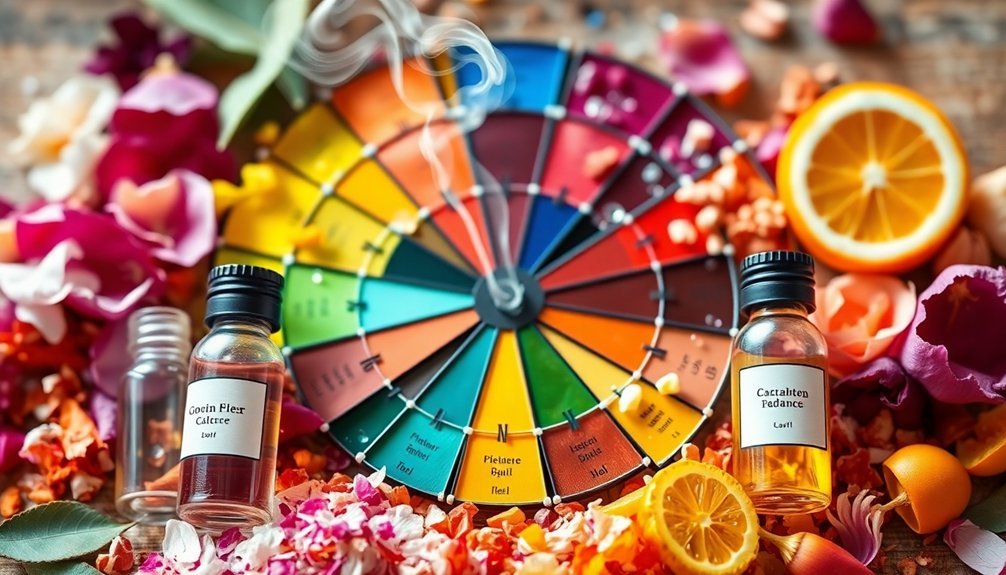
The fragrance wheel serves as a masterful compass for steering through the complex world of scent combinations. You'll find four primary families – floral, oriental, woody, and fresh – arranged in a circular pattern that instantly reveals which fragrance notes complement each other.
These families branch into subcategories, giving you a detailed map for your blending journey.
When you're mixing scents, the wheel shows you how neighboring families naturally work together. For instance, if you're working with a floral base, you can confidently pair it with citrus or fruity notes for a balanced composition.
The wheel's structure also helps you understand the relationship between top, middle, and base notes, ensuring your scent combinations maintain harmony throughout their development.
Mapping Compatible Scent Families
While traversing the diverse world of fragrances, you'll discover that certain scent families naturally gravitate toward each other.
When layering fragrances, understanding these natural partnerships helps you create sophisticated and harmonious combinations. You'll find that successful scent blending relies on identifying complementary notes that enhance rather than overpower each other.
- Floral notes pair excellently with citrus elements, creating an energetic and feminine blend
- Woody scents create depth when combined with floral or spicy notes
- Oriental fragrances blend seamlessly with vanilla and woody undertones
- Fresh and citrus scents harmonize perfectly with herbal or green notes
Testing Your Blends With Paper Strips

Start your fragrance testing process by clearly marking each strip with the oil's name and concentration to maintain accurate records of your experiments.
You'll need to apply a single drop of fragrance oil to each labeled strip, keeping them separate to prevent cross-contamination.
Wave the scented strips beneath your nose to quickly gauge how well the fragrances complement each other, paying attention to both their immediate harmony and how they evolve together.
Strip Labeling Best Practices
Successfully testing fragrance blends requires meticulous strip labeling and organization. When you're working with different scents, clear labeling guarantees you'll track each combination accurately and avoid mixing up your test strips.
Write the fragrance name directly on each strip before applying the scent, and include the date if you're planning extended testing periods.
- Use a fine-tipped permanent marker to write clearly on each strip
- Place the label at the base of the strip, away from where you'll apply the scent
- Include blend ratios or percentages if you're testing specific formulations
- Create a consistent labeling system that works for your testing process
Proper strip labeling helps you maintain a systematic approach to fragrance testing, allowing you to replicate successful blends and learn from less successful combinations.
Keep your workspace organized with labeled strips arranged in a logical order.
Wave Test For Compatibility
Before diving into complex fragrance blending, mastering the wave test technique with paper strips will help you evaluate scent compatibility effectively.
Start by placing a single drop of each fragrance you want to combine onto separate testing strips. Make sure you've labeled each strip clearly to track your scent blends.
To perform the wave test, hold the strips about six inches from your nose and gently wave them back and forth. This motion helps you detect how the top notes and base notes interact.
Let the strips dry for a few minutes to allow the initial volatile compounds to settle. You'll get a more accurate sense of how the fragrances work together once they've had time to develop.
Document your observations about each combination, noting which blends show promise and which ones clash.
Balancing Note Proportions
When creating a custom fragrance, mastering the right balance of fragrance notes is crucial for achieving a harmonious and long-lasting scent. A proven guideline suggests using 50% base notes, 30% heart notes, and 20% top notes in your blend.
Base notes should dominate your mixture to guarantee longevity, while heart notes bridge the gap between layers, creating complexity and depth in your fragrance.
- Start with the 50-30-20 ratio as your foundation
- Document each combination you try for future reference
- Adjust proportions based on your personal preferences
- Test different fragrance combinations to find your signature blend
Don't feel constrained by standard ratios – you'll want to experiment to discover what works best for your unique creation.
Keep detailed records of successful blends so you can replicate and refine them later.
Evaluating Scent Evolution Over Time
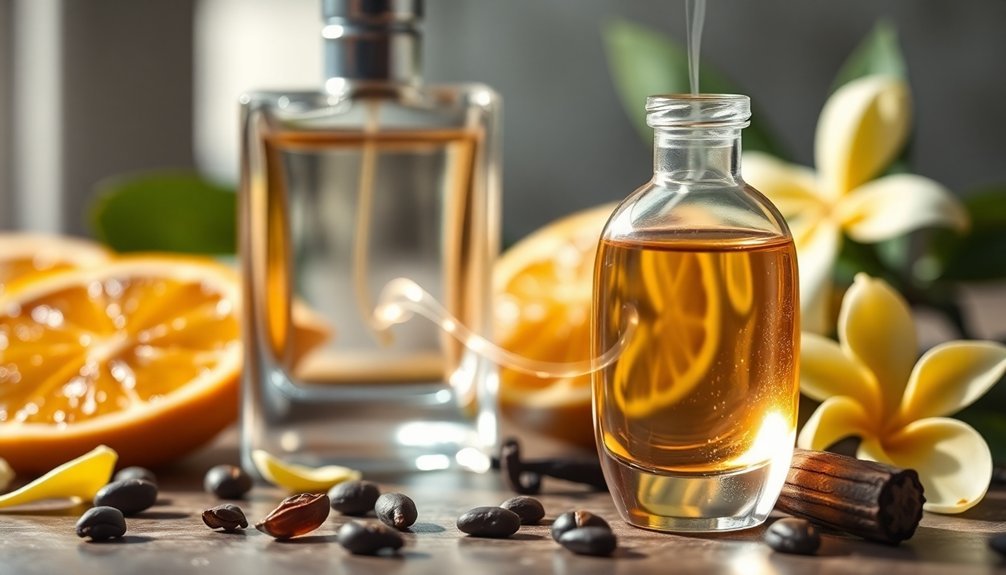
Once you've mixed your fragrance according to your chosen proportions, the real artistry begins in understanding how your creation develops over time.
Let your blend rest for several days to witness its true scent evolution. You'll notice how unique scents emerge as top notes fade and the base note becomes more prominent, usually within the first few hours.
Keep a detailed record of how your fragrance transforms at different intervals. You might discover unexpected changes that enhance your blend's character.
Natural ingredients, in particular, can surprise you – some becoming richer while others mellow out. Pay attention to these developments during the settling period, typically checking at 30-minute marks initially, then daily.
This observation process helps you master the art of predicting how your future blends will mature.
Matching Notes Across Categories
When you're pairing fragrance notes across categories, you'll find that certain families naturally complement each other, such as floral notes with citrus and woody notes with spicy orientals.
You can create dynamic contrasts by combining light top notes with deep base notes, like pairing bright citruses with rich patchouli or fresh florals with warm amber.
Classic combinations that stand the test of time include fruity-floral blends and woody-spice pairings, which offer reliable starting points for your fragrance mixing journey.
Complementary Note Families
Understanding complementary note families is essential for creating balanced, sophisticated fragrances. When you're mixing scents, certain note combinations naturally enhance each other, creating harmonious blends that are greater than the sum of their parts.
Floral notes pair beautifully with fruity elements, while woody notes find their perfect match in spicy companions.
- Combine jasmine or rose with peach or berry notes to create an uplifting, fresh fragrance that captures nature's beauty.
- Layer sandalwood or cedar with cinnamon or clove for a warm, inviting aroma that exudes comfort.
- Mix citrus notes with florals to add brightness and energy to your blend.
- Pair oriental notes like vanilla with gourmand scents such as chocolate for a rich, indulgent experience.
These complementary families work together to create complex, well-rounded fragrances that tell a complete olfactory story.
Contrasting Note Pairings
Creating truly distinctive fragrances often requires venturing beyond complementary families into the art of contrasting note pairings.
You'll discover that combining different notes from opposing fragrance families can create depth and complexity in your scents. Try pairing floral scents like jasmine or rose with woody notes such as sandalwood or cedar to achieve a balanced composition.
For a striking contrast, blend fresh citrus notes with rich oriental amber, or combine lavender with sweet vanilla.
You can also experiment with earthy patchouli alongside delicate florals, or spicy clove with fruity undertones.
These unexpected combinations will help you develop unique signature scents that stand out.
When working with contrasting notes, remember that the goal is to create harmony while maintaining the distinct character of each element.
Classic Note Combinations
Throughout the fragrance industry, certain note combinations have earned their reputation as timeless classics due to their reliable and harmonious blending potential.
When you're creating your signature scent, these classic note combinations provide a foolproof foundation for successful blending. You'll find that floral notes like lavender pair beautifully with vanilla's warmth, while rose and earthy patchouli create an enchanting balance of sweet and grounding elements.
- Bergamot + Frankincense: A perfect marriage of citrus brightness and resinous depth
- Lavender + Vanilla: Herbaceous floral meets sweet, comforting warmth
- Rose + Patchouli: Classic floral sweetness balanced with earthy undertones
- Citrus + Green Notes: Invigorating combinations like lemon with basil or mint
Start with these tried-and-true pairings, then layer them over base notes like amber or musk for added complexity.
Creating Signature Blend Combinations
When you're ready to craft your own signature fragrance, mastering the art of blending becomes essential for achieving a unique and harmonious scent. Start with the proven 20-30-50 ratio of top, heart, and base notes while documenting your combinations. Let your blends rest for several days to understand how the scents evolve.
| Note Type | Recommended Combinations |
|---|---|
| Floral | Pair with citrus for brightness |
| Woody | Blend with spicy for warmth |
| Citrus | Mix with florals for freshness |
| Spicy | Combine with woody for depth |
| Oriental | Layer with amber for richness |
Your signature scent should reflect your personality while following fundamental fragrance principles. Keep detailed records of successful combinations, including ratios and settling observations, to replicate your perfect blend consistently.
Frequently Asked Questions
How Do You Combine Fragrance Notes?
You'll want to start with base notes (50%), then add middle notes (30%), followed by top notes (20%). Test combinations on fragrance strips, let them dry, and document successful blends for future reference.
What Is the 30/50/20 Rule for Perfume?
The 30/50/20 rule helps you blend perfumes by combining 30% base notes for longevity, 50% middle notes for body, and 20% top notes for initial impact. It's a proven formula for balanced fragrances.
How to Match Fragrance Notes?
You'll want to pair complementary notes: florals with citrus or fruits, woody scents with spicy or floral elements. Start with base notes, add heart notes, then finish with top notes following the 30/50/20 rule.
What Fragrance Notes Go Together?
You'll find floral notes pair well with citrus, while woody scents complement spicy aromas. Try mixing oriental notes with vanilla or amber, and fresh green notes with fruits. Base notes like musk anchor lighter scents.
In Summary
You've now got the essential tools to start creating your own unique fragrance blends. Remember to reference the fragrance wheel, test your combinations methodically, and trust your nose. Don't be afraid to experiment with different proportions and pairings – that's how you'll discover your signature scent. With practice and patience, you'll develop an intuitive sense for which notes work harmoniously together.