
To create long-lasting homemade perfumes, you'll need a precise blend of essential oils at 25% concentration with the right ratio of notes: 15-25% top, 30-40% middle, and 45-55% base notes. Mix these with vegetable glycerine and distilled water as natural fixatives. Focus on strong base ingredients like sandalwood, patchouli, and amber for endurance. Let your creation age for 24 hours in dark glass bottles. These seven proven formulas will transform your DIY fragrance game.
Essential Ingredients for Enduring Fragrances
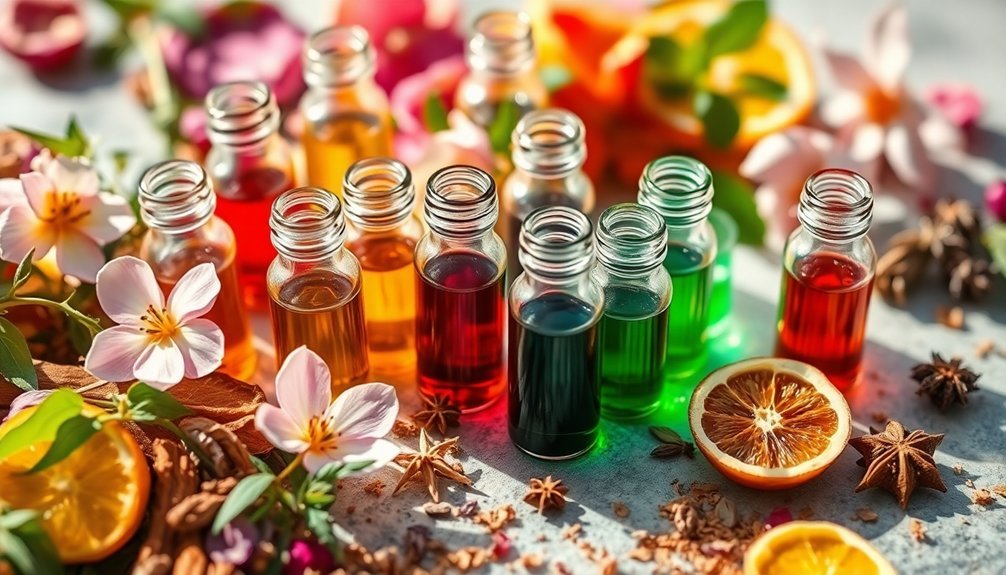
When crafting your own signature scent, the right combination of ingredients makes all the difference in creating a fragrance that lasts throughout the day.
You'll want to start with a foundation of vegetable glycerine, which creates a moisturizing barrier that helps your scent cling to your skin longer.
Select essential oils with strong base notes, like sandalwood and patchouli, as their dense molecular structure guarantees a long-lasting fragrance. Aim for a 25% concentration of essential oils in your mixture to maximize staying power.
Don't forget to add distilled water, which helps stabilize the oils and enhance the overall scent experience.
For the best results, let your perfume age for at least 24 hours, though several weeks will yield an even richer, more intense fragrance that truly endures.
The Science Behind Long-Lasting Scent Profiles
Your homemade perfume's longevity depends on understanding the critical balance between base, middle, and top notes, with base notes accounting for up to 55% of a lasting blend.
You'll achieve better scent retention by carefully measuring your oil concentrations and incorporating fixative elements like glycerine and alcohol into your formula.
The strategic use of long-lasting base notes, such as sandalwood and patchouli, creates a stable foundation that anchors lighter scents and extends their presence on your skin.
Scent Longevity Factors
Creating long-lasting fragrances requires understanding the scientific principles behind scent retention. You'll achieve the best scent longevity by using higher concentrations of fragrance oils, ideally 25% or more. Base notes, comprising 45-55% of your perfume, act as anchors that slow down evaporation and extend wear time.
| Factor | Impact on Longevity |
|---|---|
| Oil Concentration | Higher % = Longer lasting |
| Essential Oils | Heavier molecules (sandalwood, patchouli) = Extended wear |
| Environmental Conditions | Cool, dry climate = Better preservation |
To maximize staying power, incorporate fixatives like glycerine and distilled water into your formulas. When selecting essential oils, prioritize those with heavier molecular weights, as they naturally provide extended wear time. Remember that environmental factors play a significant role – cooler temperatures and lower humidity levels will help preserve your fragrance's integrity.
Oil Concentration Ratios
Understanding the science of oil concentration ratios forms the foundation of crafting enduring fragrances. When creating your DIY perfume, you'll want to aim for a 20-30% oil concentration to achieve peak longevity. This precise balance guarantees your scent won't fade quickly throughout the day.
Structure your fragrance using a time-tested formula: 15-25% top notes for immediate impact, 30-40% middle notes for harmony, and 45-55% base notes for lasting power.
Base notes are your perfume's anchor, so don't skimp on these slower-evaporating components. You can enhance your blend's staying power by adding fixatives like vegetable glycerine or essential oils such as sandalwood and patchouli.
Remember to let your creation age – this process will develop a more complex, enduring scent profile.
Fixative Notes Matter
While all perfume components contribute to a fragrance's character, fixative notes serve as the critical foundation for long-lasting scent profiles.
You'll want to focus on incorporating powerful base notes like sandalwood, patchouli, and amber, which make up 45-55% of your composition. These fixative notes work by anchoring lighter scents and preventing their quick evaporation.
To create your long-lasting perfume, combine these essential wood and resin-based oils with glycerine and distilled water. This combination enhances the overall staying power of your fragrance.
Don't rush to use your creation immediately – let it age for several weeks. This aging process allows the fixative notes to properly blend with other ingredients, resulting in a more unified and enduring scent that will last throughout the day.
Natural Fixatives and Their Role in Scent Retention
Skilled perfumers know that a fragrance's staying power depends largely on its fixatives – natural ingredients that anchor and extend the life of volatile scent molecules.
When creating your natural perfume, you'll want to incorporate powerful fixatives like benzoin, myrrh, and labdanum to lock in your chosen scents. These ingredients work by slowing down the evaporation of more delicate notes.
You can also harness the dual benefits of essential oils like sandalwood and patchouli, which serve as both aromatic components and fixatives when used in higher concentrations.
For additional stability, consider adding glycerin to your formula – it acts as a humectant that helps your fragrance cling to your skin.
Other excellent choices include oakmoss and vetiver, which not only deepen your scent but also enhance its longevity.
Crafting Your Signature Oriental-Woody Blend
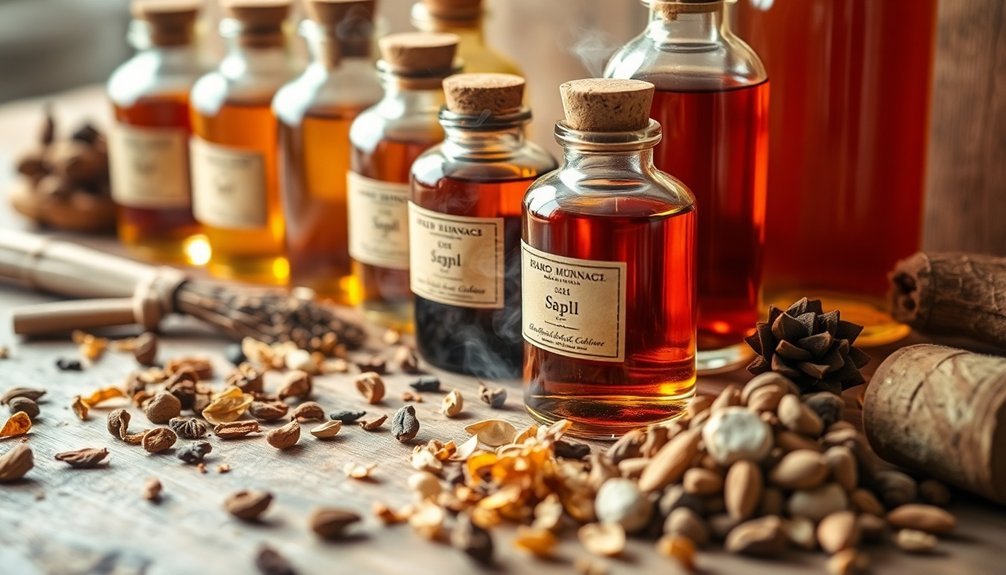
Your signature oriental-woody blend starts with a rich foundation of sandalwood and cedarwood, making up 45-55% of your fragrance composition.
You'll layer patchouli as your middle note, contributing 30-40% of the blend to create an earthy, complex character.
For a balanced finish, add bright citrus top notes like bergamot or grapefruit at 15-25% to lift the deeper woody elements.
Essential Oil Base Notes
Three foundational base notes form the backbone of any sophisticated oriental-woody fragrance blend. When you're crafting your long-lasting fragrance, you'll want to focus on essential oils like sandalwood, patchouli, and cedarwood, which typically make up 45-55% of your final blend.
Each base note brings unique characteristics to your perfume. Sandalwood's smooth, sweet profile enhances your fragrance's longevity, while patchouli adds an intense, earthy depth that grounds the composition.
Cedarwood's warm, balsamic qualities make it particularly versatile, as it pairs beautifully with both floral and citrus top notes. For the best results, choose aged essential oils, as they'll provide enhanced complexity to your blend.
The quality of these base notes will profoundly impact your perfume's overall depth and staying power.
Blending Spices With Woods
Building upon the rich foundation of woody base notes, blending spices creates an intriguing oriental fragrance with greater depth and warmth.
You'll want to start with essential oils like sandalwood, cedarwood, or patchouli as your base, then layer in warming spices such as cinnamon, cardamom, and clove to enhance the complexity.
For a balanced blend that lasts, try mixing 20 drops of woody notes with 10 drops of spices.
You can fine-tune this ratio to match your preferences while maintaining the fragrance's longevity.
Consider adding lighter top notes, like citrus, or middle notes, such as florals, to create a more dynamic scent profile.
Remember that the higher concentration of woody notes and spices will help your perfume stay longer on your skin.
Floral-Based Formulas That Stand the Test of Time
While creating a lasting floral fragrance may seem intimidating, understanding the right proportions and ingredients can help you craft timeless scents that rival commercial perfumes. You'll need to balance your essential oils carefully, following the 15-25-55 rule for a well-structured Homemade Perfume that endures.
| Component | Recommended Ingredients |
|---|---|
| Top Notes | Rose Essential Oil |
| Middle Notes | Lavender, Jasmine |
| Base Notes | Sandalwood, Cedarwood |
| Proportions | 15-25% Top, 30-40% Middle |
| Carrier | Jojoba or Sweet Almond Oil |
For the most lasting floral fragrances, start with precious jasmine as your centerpiece, which provides exceptional longevity. Complement it with lavender's balmy characteristics, then anchor your blend with woody base notes. Remember that geranium can add depth while extending wear time, making it an excellent addition to your formula.
Mastering the Art of Layering Fragrance Notes
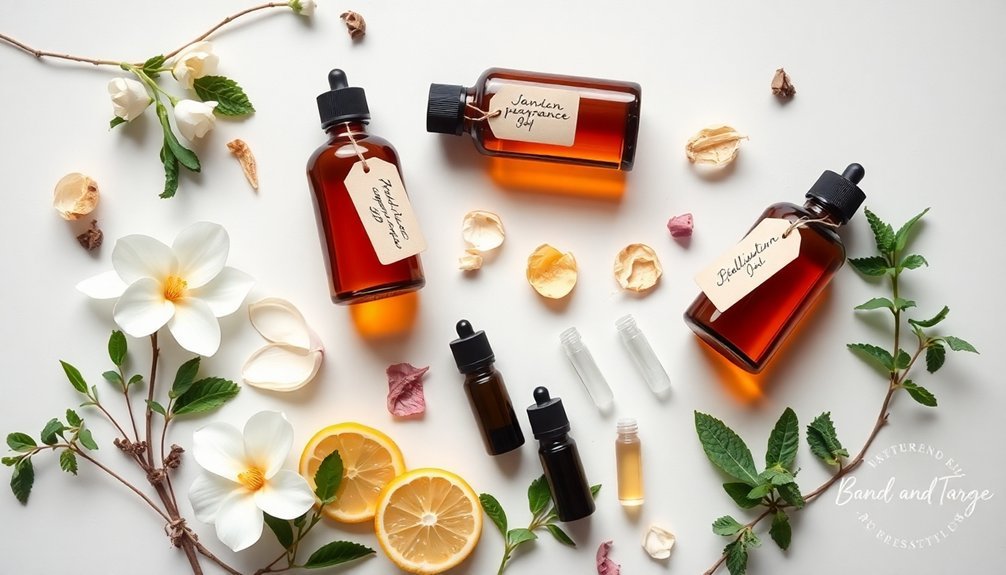
Successful fragrance layering demands a deep understanding of how scent notes interact and evolve over time.
Creating a harmonious fragrance requires mastering the delicate dance of scents as they unfold throughout the day.
You'll want to start by selecting your top notes, which make up 15-25% of your formula and create that vital first impression. While these dissipate quickly, they set the stage for your fragrance's journey.
Next, focus on middle notes, comprising 30-40% of your blend. These essential oils form the heart of your perfume and provide lasting balance.
The final step involves choosing base notes, which should make up 45-55% of your formula. They'll anchor your fragrance and help those lighter notes linger longer on your skin.
Storage and Preservation Techniques for DIY Perfumes
Proper storage techniques can make or break your homemade perfumes. To guarantee your DIY fragrances maintain their quality, you'll need to focus on three key preservation factors: light, temperature, and air exposure.
Store your perfumes in opaque glass bottles to shield essential oils from light damage, which can degrade their potency. Keep your creations in a cool, dark space – heat and humidity are your fragrance's worst enemies.
You'll also want to use airtight containers to prevent oxidation, which can alter the scent profile.
With proper storage, your perfumes can last anywhere from 6 months to several years. Natural essential oils typically have shorter shelf lives than synthetic ingredients.
Don't forget to check your fragrances regularly for any changes in scent or appearance, and discard them if you notice any off-putting smells.
Frequently Asked Questions
What Ingredient Is Best for Long-Lasting Perfume?
You'll get the longest-lasting perfume by combining glycerin as a fixative with a 25% concentration of essential oils, particularly base notes like sandalwood. Don't forget to use high-quality isopropyl alcohol (91%+).
How to Make Homemade Perfume Scent Last Longer?
You'll make your homemade perfume last longer by adding vegetable glycerine, using 25% essential oil concentration, applying to pulse points, letting it age properly, and storing in a cool, dark place.
What Chemical Makes Fragrance Last Longer?
You'll find glycerin and isopropyl alcohol are key chemicals that make fragrances last longer. They work by attracting moisture and slowing down evaporation. Base notes like sandalwood also provide natural staying power.
How to Create a Long-Lasting Fragrance?
You'll create a lasting fragrance by using 25% essential oils, mixing base notes like sandalwood, adding glycerine and distilled water, aging for 24 hours, and applying to pulse points for maximum longevity.
In Summary
Now you're equipped to create long-lasting perfumes that rival commercial fragrances. Remember to properly blend your essential oils with natural fixatives, layer your notes thoughtfully, and store your creations in dark glass bottles away from light and heat. Don't forget to let your blends mature for at least two weeks before use. With these seven formulas, you'll craft unique, enduring scents that truly reflect your personality.