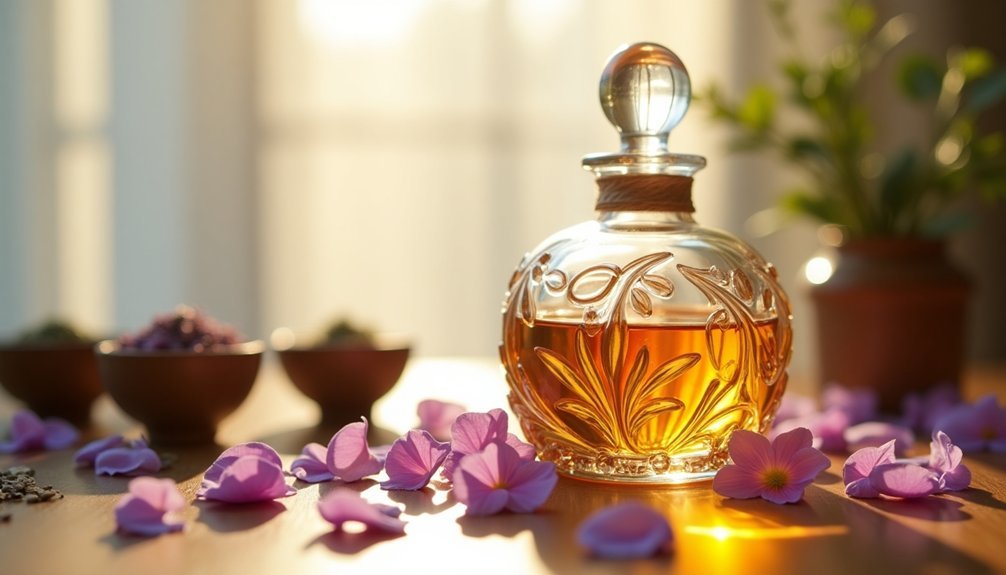
To make your homemade perfumes last all day, you'll need to focus on three key elements: proper fixatives, carrier oils, and essential oil concentrations. Use natural fixatives like benzoin or myrrh to slow down evaporation, and maintain a 25% essential oil concentration with a 91:9 ratio of alcohol to water. Add glycerine to bind scent molecules, and layer your fragrances with matching body products. There's much more to discover about creating the perfect long-lasting signature scent.
Understanding Natural Fixatives in Perfumery
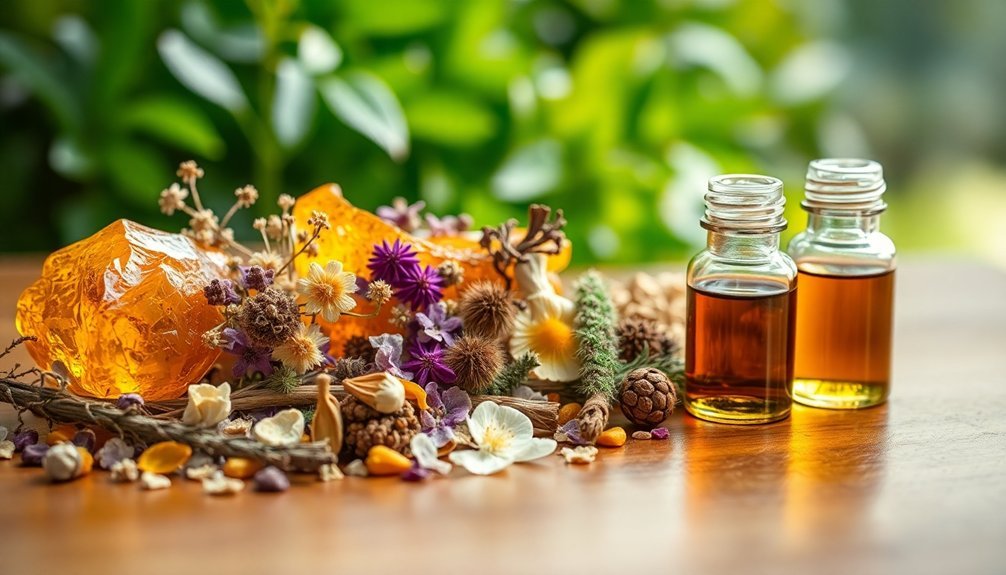
When creating your own perfumes, understanding natural fixatives is essential for achieving long-lasting fragrances.
These powerful substances work by slowing down the evaporation of fragrance compounds, helping your scent stay noticeable throughout the day. You'll find that resins like benzoin and myrrh not only extend your perfume's life but also add rich depth to your creation.
Natural fixatives are the secret to lasting perfumes, anchoring delicate scents while adding their own mysterious depths to your fragrance.
Essential oils can serve as excellent natural fixatives too. Vetiver, patchouli, and sandalwood are particularly effective at anchoring your scent while contributing to its base notes.
For an extra boost in stability, try adding a small amount of vegetable glycerin to your blend. This combination of fixatives doesn't just improve longevity – it creates a more complex and balanced fragrance profile that evolves beautifully on your skin.
Essential Ingredients for Long-Lasting Scent Profiles
To create perfumes that last throughout the day, you'll need to master the combination of key ingredients that form the foundation of enduring fragrances. Start by incorporating essential oils with rich base notes like sandalwood, patchouli, and vanilla, which provide depth and lasting power to your blend.
For ideal staying power, aim for a higher concentration of essential oils, around 25% of your formula. Add glycerine to help bind the scent molecules to your skin, and include distilled water to soften the overall fragrance while extending its longevity.
You'll achieve the best results by layering different scent notes in your composition. This strategic combination of top, middle, and base notes creates a complex fragrance profile that maintains its presence throughout the day.
The Role of Carrier Oils in Fragrance Retention
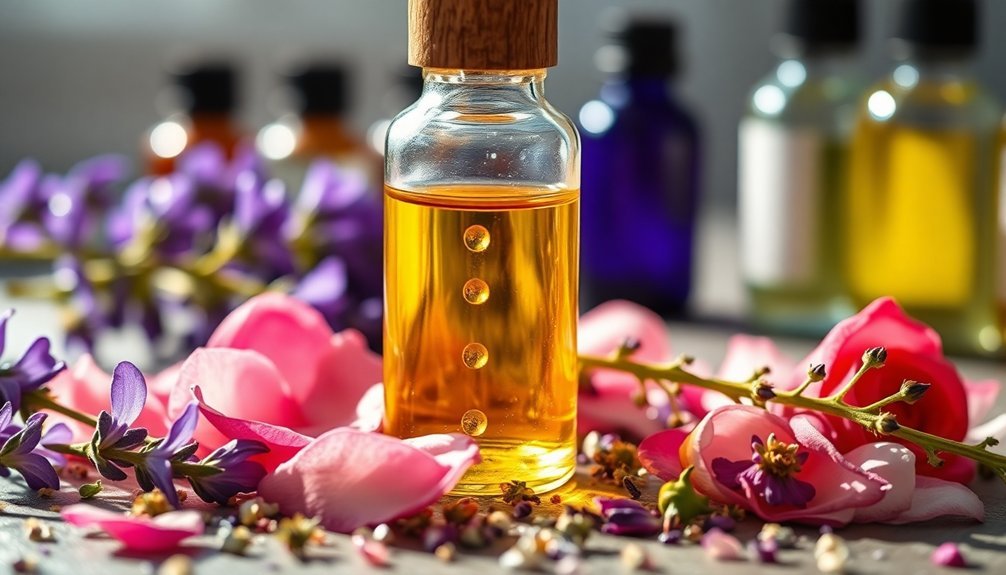
Building upon your foundation of lasting fragrances, carrier oils play a powerful role in extending the life of your homemade perfumes. You'll find that these oils create a moisturizing barrier on your skin that locks in essential oils, greatly improving fragrance retention throughout the day. By slowing down the evaporation of volatile components, you'll enjoy a more consistent scent experience.
| Carrier Oil | Benefits |
|---|---|
| Jojoba | Closest match to skin's natural oils |
| Sweet Almond | Rich in fatty acids for lasting hold |
| Fractionated Coconut | Fast absorption, clear finish |
| Grapeseed | Light texture, suitable for all skin types |
When you blend your essential oils with carrier oils, you'll notice your fragrances feel softer and more balanced, while maintaining their presence for longer periods compared to alcohol-based alternatives.
Optimal Ratios for Extended Wear Performance
To create a long-lasting homemade perfume, you'll need to maintain a precise balance of 25% essential oils mixed with a 91:9 ratio of isopropyl alcohol to distilled water.
Your essential oil blend should follow a structured composition of 3 top notes, 5 middle notes, and 2 base notes to achieve ideal complexity and staying power.
Adding vegetable glycerine as a fixative will help bind your fragrance molecules to the skin, ensuring your scent lingers throughout the day.
Oil-to-Alcohol Balance Matters
When crafting homemade perfumes, achieving the right oil-to-alcohol balance can make the difference between a fragrance that fades quickly and one that lasts throughout the day. You'll want to aim for a 25% concentration of oil to maximize longevity while maintaining a pleasant scent profile.
| Component | Amount | Purpose |
|---|---|---|
| Alcohol | 5-8 tsp | Base carrier |
| Glycerine | ¼ tsp | Moisture retention |
| Water | ½ tsp | Stabilizer |
| Essential Oils | 10 drops | Fragrance |
To enhance staying power, combine 3 top notes, 5 middle notes, and 2 base notes of essential oils with your base mixture. Don't forget to add glycerine – it's vital for moisture retention and extended wear. After blending, let your perfume set for at least 24 hours to allow the ingredients to meld properly.
Essential Oil Blending Secrets
Understanding the art of oil blending can transform your homemade perfume from a simple scent into a long-lasting signature fragrance.
You'll want to follow the proven 3-5-2 ratio: three parts top notes, five parts middle notes, and two parts base notes. This combination guarantees ideal scent retention throughout your day.
To maximize longevity, incorporate fixative oils like sandalwood, patchouli, or myrrh as your base notes. These powerful ingredients slow down the evaporation of more volatile essential oils.
Aim for a 25% concentration of essential oils in your total mixture, and don't forget to add glycerine – it helps bind the oils to your skin.
Before wearing your creation, let it mature for 24 hours. This resting period allows the scents to meld together, creating a more unified and enduring fragrance.
Proper Fixative Proportions Guide
While crafting your signature scent, achieving the right fixative proportions makes all the difference in your perfume's longevity.
You'll want to aim for 10-20% fixatives in your total blend to properly anchor the fragrance. Combine both natural and synthetic fixatives like benzoin, myrrh, or labdanum for enhanced depth.
For a well-balanced composition, start with a 3:5:2 ratio of top notes to middle notes to base notes. Base notes, such as sandalwood or vanilla, serve as excellent fixatives and can extend wear time considerably.
When blending your essential oils with fixatives, you'll need to let the mixture mature for at least 48 hours. This waiting period allows the scent to stabilize and develop its full character, ensuring your perfume stays vibrant throughout the day.
Base Note Selection for Maximum Longevity
To achieve a long-lasting homemade perfume, you'll need to master the art of base note selection. These foundational ingredients are essential for extending your fragrance experience and creating a scent that stays with you throughout the day.
Base notes are the secret to enduring fragrance, forming the essential foundation of a perfectly crafted homemade perfume.
When formulating your homemade perfume, aim to include 20-30% base notes for ideal staying power.
- Choose rich, deep ingredients like patchouli, sandalwood, or tonka bean to anchor your blend.
- Incorporate woody elements and musk to enhance the complexity of your fragrance.
- Add vanilla or amber notes to create warmth and depth.
- Layer multiple base notes to build a strong foundation that prevents quick dissipation.
Strategic Blending Techniques for Lasting Power
Creating a perfume that lasts requires strategic blending techniques beyond just selecting quality ingredients.
You'll want to focus on achieving a 25% concentration of essential oils in your blend, with an emphasis on base notes like amber, musk, or sandalwood. These heavier scents serve as your fragrance's foundation and naturally enhance wear time.
Add vegetable glycerine as a fixative to help your scent bind effectively to your skin.
When implementing your strategic blending techniques, remember to balance your base notes with complementary middle and top notes, but maintain that higher ratio of base notes for longevity.
Let your creation rest for at least 24 hours to allow the scents to meld together properly.
Store your finished perfume in a cool, dark place to preserve its potency.
Storage Solutions to Preserve Scent Strength
Since your homemade perfume's quality depends heavily on proper storage, you'll need to protect your creation from its three biggest enemies: light, heat, and air.
The right storage solutions will help maintain your perfume's scent strength and extend its lifespan considerably.
Keep these essential storage practices in mind:
- Store your perfumes in cool places, away from bathrooms or windowsills where temperature fluctuations occur.
- Use opaque or dark-tinted glass bottles to shield fragrances from harmful light exposure.
- Verify bottles remain tightly sealed when not in use to prevent oxidation.
- Choose a dedicated storage space that's consistently dark and temperature-controlled.
Proper storage isn't just about preservation—it's about maintaining the integrity of your carefully crafted scents.
With these practices, you'll help your homemade perfumes retain their intended fragrance profile longer.
Enhancing Fragrance With Botanical Extracts
Natural botanical extracts serve as powerful allies in elevating your homemade perfume's complexity and longevity. When you're crafting your signature scent, you'll want to incorporate a thoughtful blend of top, middle, and base notes from these extracts.
Base notes like patchouli and sandalwood provide essential lasting power to your creation.
To maximize your fragrance experience, consider adding ingredients with natural fixative properties, such as vetiver and amber. These help slow down the evaporation of lighter scents, ensuring your perfume stays noticeable throughout the day.
You can also enhance the staying power by including vegetable glycerin, which binds scent molecules together. For added depth, try layering hydrosols or floral waters with your botanical extracts – they'll contribute subtle nuances while helping your perfume last longer.
The Science Behind Scent Molecules
The science of scent molecules reveals why your homemade perfume's staying power depends on molecular weight, with heavier base notes lingering while lighter top notes quickly fade.
You'll notice how heat from your skin temperature activates fragrance bonds, releasing scent molecules into the air as you wear your perfume throughout the day.
Your oil-based fragrance notes will last considerably longer than alcohol-based ones, as their larger molecules evaporate more slowly and bond more effectively with your skin's natural oils.
Molecular Weight Affects Duration
When crafting homemade perfumes, understanding molecular weight becomes essential for achieving long-lasting scents. The heavier the molecules in your fragrance notes, the longer they'll stay on your skin. You'll notice that base notes like amber and musk provide better longevity than lighter citrus and floral scents.
To create perfumes that last all day, consider these molecular weight principles:
- Heavy molecules (200-300 Daltons) evaporate slowly, making them ideal for base notes.
- Light molecules (50-100 Daltons) evaporate quickly, working best as top notes.
- Essential oils with higher molecular weights provide better staying power.
- Balancing light and heavy molecules creates a well-rounded scent profile.
Heat Activates Fragrance Bonds
Building on our understanding of molecular weight, heat plays a fascinating role in how fragrance molecules behave on your skin. When you apply your homemade perfume to warm areas of your body, particularly pulse points like your wrists and neck, you're actually helping the scent last longer.
Heat increases the kinetic energy of fragrance molecules, causing them to evaporate more slowly and creating a sustained release throughout the day.
Your body's natural warmth interacts with the different scent components in unique ways. While lighter top notes quickly disperse, heat helps stabilize the heavier base notes, extending their longevity.
The interaction between your skin's natural oils and the fragrance compounds creates a personalized scent profile that evolves over time, ensuring your perfume stays noticeable longer.
Oil-Based Notes Linger Longer
Understanding why oil-based notes last longer begins with their molecular structure. When you're creating homemade perfumes, these larger scent molecules bond effectively with your skin's natural oils, creating a more persistent fragrance experience.
Here's how oil-based notes enhance your perfume's longevity:
- Base notes like sandalwood, vanilla, and patchouli have low volatility, allowing them to stay on your skin for extended periods.
- Essential oils contain complex compounds that evolve throughout the day, creating a dynamic scent journey.
- Oil-based formulations evaporate more slowly than alcohol-based alternatives, maintaining their presence longer.
- Including 25% oil-based notes in your homemade perfume formula maximizes the fragrance's staying power.
Natural vs. Synthetic Fixative Components
The choice between natural and synthetic fixatives marks an essential decision point in crafting your homemade perfume. When you're aiming for long-lasting perfumes, both options offer unique benefits.
Natural oils combined with resins and balsams like benzoin and labdanum add depth while slowing down evaporation. In contrast, synthetic fixatives such as ambroxan provide consistent performance and modern appeal.
You don't have to choose just one approach. By combining both natural and synthetic fixatives at 10-20% of your total mixture, you'll create a balanced fragrance that maintains its character throughout the day.
Natural components contribute complexity and warmth, while synthetic elements guarantee stability. This hybrid approach gives you the best of both worlds: the authentic charm of natural ingredients with the reliable performance of modern synthetics.
Application Methods for Extended Wear Time
You'll maximize your homemade perfume's longevity by applying it strategically to pulse points like your wrists, neck, and behind your ears, where natural body heat enhances the fragrance projection.
For an even longer-lasting scent experience, try layering your perfume with matching scented body lotions or oils before the final fragrance application.
Remember not to rub your wrists together after applying the perfume, as this can break down the fragrance molecules and diminish their staying power.
Strategic Pulse Point Application
Strategic placement of your homemade perfume can make all the difference in how long it lasts throughout the day.
Start by hydrating your skin with an unscented lotion to create a moisturized base that helps your fragrance adhere better.
When applying perfume, focus on your body's natural pulse points where heat will amplify and project your scent.
Key pulse points for ideal fragrance projection:
- Wrists and inner elbows (but don't rub them together)
- Both sides of your neck and behind ears
- Behind your knees for rising scent
- Ankles for lasting fragrance trail
You'll get the most out of your homemade perfume by layering scents with matching products and letting the fragrance molecules remain intact on these strategic spots.
Layering Multiple Scent Products
Building upon smart pulse point application, layering multiple scented products creates an even more lasting impression with your homemade perfume.
Start by applying a hydrating base like a glycerin-infused lotion to help fragrance molecules stick to your skin. You'll want to use either an unscented moisturizer to prevent clashing or a matching scented body lotion to enhance your perfume's notes.
After moisturizing, focus on applying perfume to your pulse points. The combination of layered products helps your fragrance last longer throughout the day.
For maximum fragrance longevity, consider adding a light spritz of your homemade perfume to your clothing, as fabric retains scent better than skin.
This multi-layered approach creates a cohesive scent experience that'll keep you smelling wonderful from morning to night.
Frequently Asked Questions
How to Make Perfume Last All Day Long?
You'll get longer-lasting perfume by adding glycerine, applying it to damp skin, using 25% essential oils, layering complementary scents, and storing it properly. Moisturize well before application for best results.
What Ingredient Makes Perfumes Last Longer?
You'll get longer-lasting perfumes by using glycerine as a humectant, high concentrations of essential oils (25%), and base notes like sandalwood. Adding 91% isopropyl alcohol helps preserve the fragrance and improves its longevity.
How to Make Long Lasting Perfume at Home?
You'll need high-proof isopropyl alcohol, vegetable glycerine, and essential oils (3 top, 5 middle, 2 base notes). Mix them together, let sit for 24 hours, and apply to moisturized pulse points.
What Is the Secret to a Long-Lasting Scent?
You'll achieve long-lasting scent by using 25% essential oil concentration, adding glycerine as a fixative, blending top, middle, and base notes, storing in dark places, and applying to moisturized skin for better retention.
In Summary
You'll find that creating long-lasting homemade perfumes comes down to careful formulation and proper technique. By using the right fixatives, selecting complementary base notes, and maintaining ideal ratios of essential oils to carriers, you're setting yourself up for success. Remember to store your creations properly and apply them strategically to pulse points—these simple steps will help your signature scent last throughout the day.